
Ishita Sharma
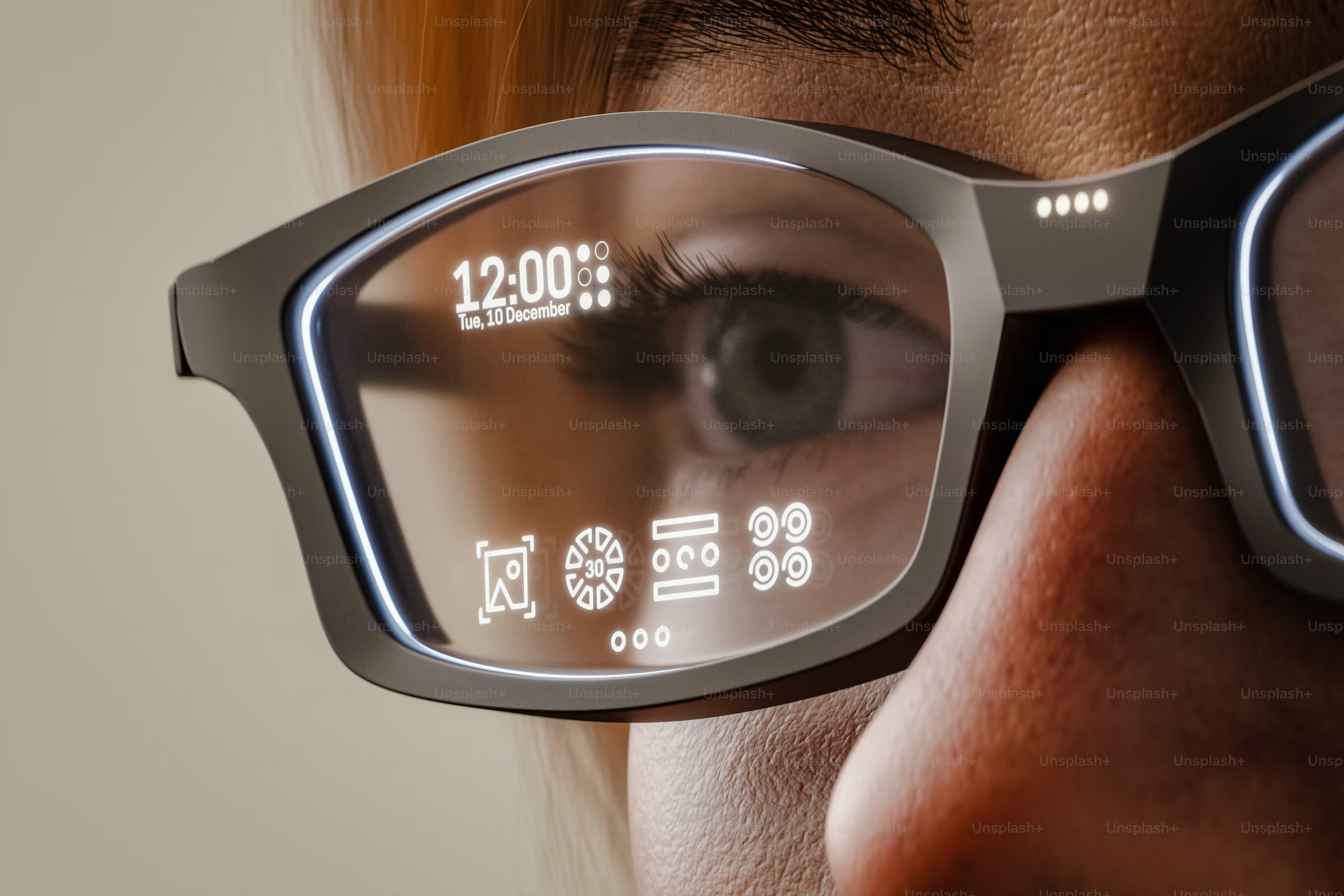
Abstract: Meta’s smart glasses make covert filming ordinary. This article argues the harm is gender-based violence, rather than a privacy breach. Covert-filming law protects only concealment already secured, reaching a woman indoors and abandoning her on the street. It proposes conditioning device sales, extending erasure rights to unwitting subjects, and withdrawing India’s CEDAW declaration.
In February 2026, Swedish newspapers reported that video from the Meta AI glasses was reaching workers at Sama, a contractor in Nairobi, who labeled it to train the product’s models. Women filmed undressing, in bathrooms, engaged in intercourse, most of them unaware a camera was on, were watched and labelled by strangers to train Meta’s software. While this absolutely is a privacy violation, calling it out only understates it. This piece argues that Meta’s glasses produce gender-based violence against women and that International human rights law cannot reach that violence. This is because it routes responsibility for a corporation’s conduct through the corporation’s home State, and Meta’s home State has never ratified the treaty that would impose it. India, which has ratified, is free to take action against this concern but fails to do so. The glasses are already here, sold in India as the Oakley Meta line, with Virat Kohli as its face. In Delhi in late March this year, a creator wearing Ray-Ban Meta glasses filmed a transgender-rights protest that had asked volunteers to stop exactly that, because many of those present had not publicly disclosed their sexual identity. By May the footage, edited to mock them, had passed three million views. What happens after the recording is circulated can be seen in Bengaluru, where police arrested a man last July who had covertly filmed women with his phone and posted more than fifty reels focused on their bodies. A student he filmed could not get Instagram to take her video down, and strangers sent her vulgar messages while it stayed up. Bengaluru shows the practice and the failure of the remedies. The glasses are the same practice with the camera made invisible.
The argument runs in five parts. Part I sets out the framework, and argues that this harm belongs in the register of equality rather than privacy. Part II applies that framework to the law of covert filming and to the strongest defences of privacy. Part III traces the governance gap that leaves the harm unanswered at the international level. Part IV shows where India’s own law fails. Part V sets out what closing the gap would require.
Part I: An equality question
Catharine MacKinnon’s dominance approach, the leading version of what the literature now calls anti-subordination, asks a different question of a legal rule. Not whether a woman has been treated differently from a man, but whether the rule keeps her in a subordinate position: “an equality question is a question of the distribution of power.” She noticed that harms done almost only to women were being read out of sex equality law for that very reason, because with no male comparator available they registered as a difference between the sexes rather than as the subjection of one of them. Covert sexualised filming has that shape, men are filmed too, but a man filmed on a street does not thereby become material for strangers to assess.
Her account of privacy explains the rest. Privacy law does not give anyone a condition of not being observed, it protects the condition a person has already secured, so it does most for those who had privacy to begin with and least for those who had none. In her words, “No one who does not already have them socially is granted them legally.” A woman in a room with a door has something the law can recognise, in contrast to a woman on a street. Covert-filming offences turn on that difference, as shown in Part IV.
What this article borrows is that diagnostic question, namely what a legal test actually measures. One consequence that carries into the rest of the argument is that a privacy claim has a single intruder and a single intrusion built into its structure, whereas a subordination claim asks what arrangement produces the pattern, and an arrangement has more participants than an intruder does.
Part II: Why call this violence rather than privacy?
The offences that govern covert filming, in India as in most common-law systems, condition liability on intimacy. A “private act,” a “private area,” a place where nudity is expected. Each formula asks what the woman had already secured for herself. A closed door is seclusion she obtained, and a state of undress is exposure that only the seclusion made possible. Whether the woman filmed clothed on an Indian street is protected at all depends on what the camera caught, which is another way of saying it depends on how much concealment she had achieved before it did.
A few systems have moved off this axis. Canada keys its voyeurism offence to recording done for a sexual purpose, and in R v Jarvis, its Supreme Court convicted a teacher who filmed clothed students, holding they kept a reasonable expectation of privacy even at school. The judgment is rightly regarded as expansive. But the Court reached that result by observing that the camera dwelt on the students’ intimate body parts at close range and that the recordings were objectively sexual, but the offence in any event still needs a sexual purpose. Germany criminalises capture that invades a person’s intimate sphere and separately gives civil protection to one’s image.
The men who run “creepshot” forums (sites devoted to covert sexualised photographs of clothed women in public), quote the doctrine back as their license, telling women that “in public, you do not have a reasonable expectation of privacy“. That is the problem, although privacy’s best defenders have answers. Danielle Citron enlarges privacy to cover a person’s intimate life as such, but even so, traditional privacy law largely limits the injury to one woman’s lost control against one intruder. It cannot name the pattern of men doing this to women as a class, and it cannot reach past the wearer, to the company whose pipeline carries the image on. This conduct has been named image-based sexual abuse, placing it on Liz Kelly’s continuum of sexual violence. That framing measures the perpetrator’s act, rather than what was exposed. The act is complete at capture, with victims describing it in the register of assault rather than data loss, and its injury sitting in others’ judgment of her, not in her lost control of information.
Part III: The Governance Gap
CEDAW General Recommendation No. 35 treats gender-based violence as connected, recurring forms, expressly including technology-mediated ones, and directs States at the structures that produce the violence rather than at single acts. Meta’s pipeline is that continuum in motion, from capture, review in Nairobi, to model training. Each stage carries the woman’s loss of control to hands and uses she never allowed. This frame relocates responsibility from the recorder to the enterprise whose product and data chain the image travels down, a linkage the Guiding Principles themselves recognise when a harm is tied to a company’s products by its business relationships.
The UN Guiding Principles require enterprises to respect human rights, and the UN Working Group’s gender guidance report directs companies to treat gendered harms as salient risks and to weigh their differentiated impact on women. Yet the Guiding Principles were John Ruggie’s answer to what he called the governance gap, corporate power operating across borders at a scale no single State can regulate, and after binding rules failed, he filled that gap with a voluntary standard. So compulsion must come from a State, above all the State where the corporation is based. Where the home State and victims coincide, this can work. When Facebook harvested the facial data of Illinois users, that state’s biometric law forced a 650-million-dollar settlement, a sub-national instance of the home jurisdiction’s power to bite. Meta’s home State is the United States, the only major industrialised democracy to have signed CEDAW and never ratified it. India, which did ratify, owes its own duty. It can set the terms on which the glasses are sold or impose other conditions, and through those terms reach how they are built..
Part IV: Where India Falls Short
Socio-legal research on cyber-violence against Indian women documents that a woman is treated as the keeper of her family’s honour, that a sexualised image shames her and her family together, and that victims routinely forgo complaints to protect reputation. The injury comes from the community’s judgment more than the image’s reach, which was proved by The Delhi protest. The injury was being exposed and mocked before the particular audiences whose judgment governs a person’s life. For the trans and queer people filmed there, it carried a further harm of forced outing, which is why the point holds for women in all their diversity, as GR 35 itself insists.
Against that harm, India’s law fails at three points. Firstly the criminal act of Voyeurism under Section 77 of the BNS requires a woman to be engaged in a private act. Explanation 1 defines that by a place condition and a state condition together. The watching must occur where privacy would reasonably be expected, and the woman must be exposed or in underwear, or using a lavatory, or engaged in a sexual act not ordinarily done in public.
Secondly, the DPDP Act, once its main provisions commence in May 2027, cannot be invoked by those who would need its protection the most. Its rights, to notice, access, erase and complain to the new Data Protection Board, all assume a person who knows her data was taken and can name the company holding it. The recorded bystander knows neither, and the Act, unlike Europe’s Article 14, obliges no one to tell her.
Finally, one could try the constitutional route instead, since some Indian courts may now allow privacy claims against private parties, but that road ends even earlier. In Kaushal Kishor v State of Uttar Pradesh (2023), a Constitution Bench declared that a fundamental right under Article 19 or 21 can be enforced against persons other than the State. It then said nothing about what remedy follows, which is why the horizontality it proclaimed has been described as never operationalised. Whatever remedy eventually attaches, it will require the bystander to identify a defendant and prove a recording. She may not be able to do either, since she may not even know the footage exists, or who was wearing the glasses.
Underneath all three sits a fourth problem, of a different kind. The obligation that speaks most directly to this harm is CEDAW’s obligation to change the social patterns that make the image a weapon. It is one India arguably reserved against in 1993, declaring it would apply Articles 5(a) and 16(1) only without interference in any community’s personal affairs absent that community’s initiative and consent. Treaty partners have also objected that this is a reservation in the guise of a declaration, and incompatible with the Convention’s object and purpose.
Part V: The Way Forward
There should be, first, condition market entry, i.e. no sale of camera glasses capable of covert capture unless recording is signalled in a way bystanders can perceive and the wearer cannot switch off. This need is documented at both ends. The BBC found tutorials for covering the indicator light, and workers at Sama reported footage from wearers who did not know their own glasses were recording. The demand also has precedent, since the Irish and Italian data authorities pressed Meta in 2021 to prove the light gave real notice. South Korea is an example of a country that has successfully regulated a device. A telecommunications standard adopted in South Korea in 2004, requires mobile phones sold there to emit a photographing sound of 60 to 68 decibels, and was adopted to prevent the misuse of phone cameras. India holds the same lever. Section 19(c) of the Telecommunications Act, 2023 empowers the Central Government to notify standards for the manufacture, import, distribution and sale of telecommunication equipment, and the sale or use in India of equipment to which such a standard applies without a certificate of conformity is barred.
Second, the DPDP Act must be amended to add a duty, on the Article 14 model, letting a person whose data a company takes without dealing with her, locate and erase footage of herself. A route she triggers, since the company cannot notify a stranger it cannot name. Third, make the erasure duty reach the platform and not only the device-maker. Meta appears in this story twice, as the manufacturer and as the owner of Instagram, which hosted the Bengaluru reels and did not remove them when asked. India’s IT Rules’ 2026 amendment cut takedown to two hours for intimate or morphed images and three for content under a government order, but clothed reels qualify for neither. Fourth, withdraw the declaration. Treaty partners have objected that it is incompatible with the Convention, and on the view it is invalid and severable, India is bound anyway. The objection that withdrawal would trample cultural complexity is addressed by India’s record itself. The Hindu Succession Amendment of 2005 rewrote inheritance rights for women inside a religious community. In Shayara Bano v UOI, the Supreme Court struck down instant triple talaq, the practice by which a husband could end a marriage by pronouncing the word three times in a single sitting. Legislation followed in 2019 and both operated inside Muslim personal law. In Vishaka v State of Rajasthan, the Supreme Court applied CEDAW directly to build workplace sexual harassment law. Community consent was not awaited in each case. The declaration now only signals that the State’s commitment to changing gendered norms is conditional.
Conclusion
None of these four measures names women and each would protect a man recorded without his knowledge as readily as a woman. What turns the covert recording of a clothed woman into an injury is not the recording, but the judgment for the image once it circulates, which does not fall on men and women alike. This is why, within India’s own crime records, there has been a sharp rise in cybercrimes targeting women.
Little of what remains is beyond reach. Two of the four would amend a statute whose substantive provisions do not commence until May 2027. A third rests on a power the Central Government already holds under the Telecommunications Act. The fourth needs no legislation at all, since a declaration can be withdrawn by notifying the depositary. Withdrawal on its own would settle little, however, India has taken measures before, inside personal law, without waiting for a community to agree.
None of them depends on Meta or the United States ratifying a treaty it has set aside for more than four decades. The glasses are already on sale, and the standard set for them here is likely to shape what is expected of the devices that follow.
Ishita Sharma is a Final-Year Law student at Jindal Global Law School (JGLS), India. She currently works as a paralegal at the Child Rights Clinic and as a research assistant in the Environmental Law Clinic at JGLS. Through her work, she aims to protect and empower vulnerable communities.