
Agam Gupta
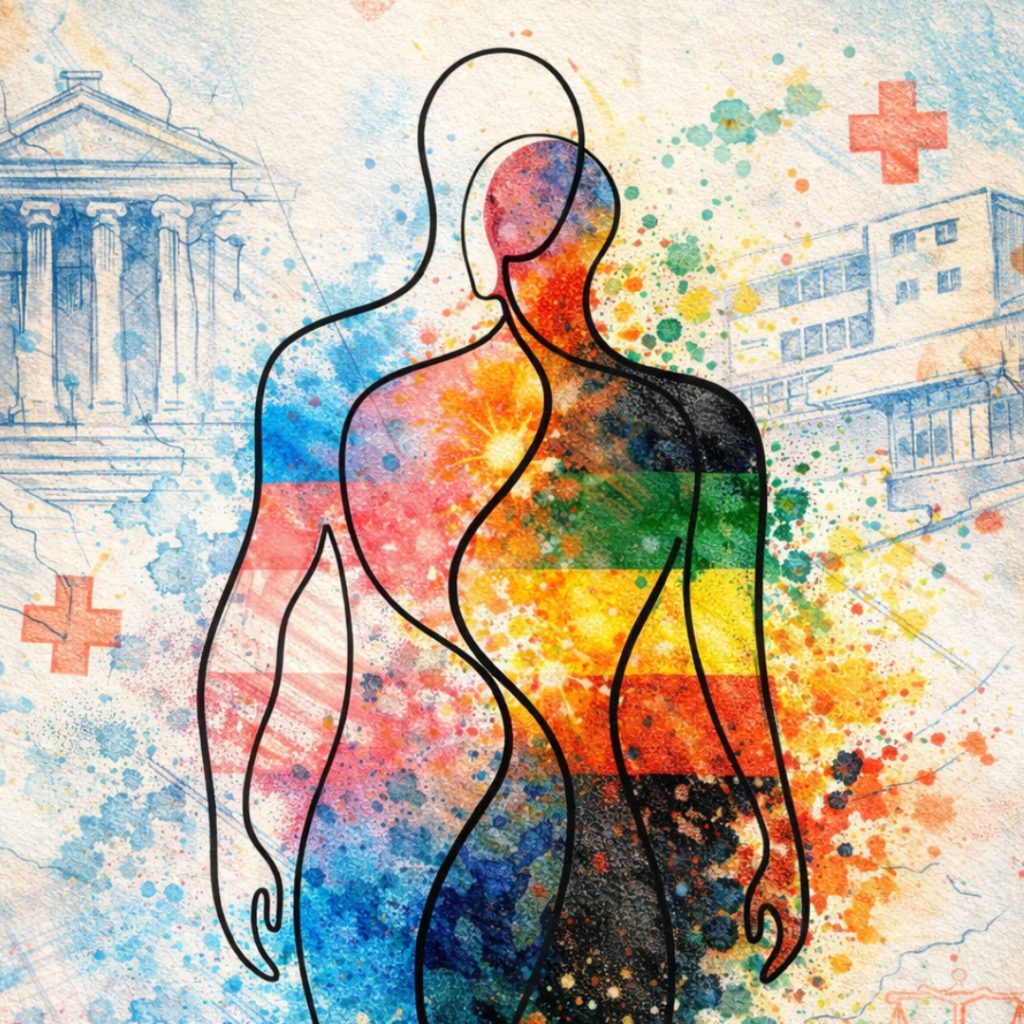
Abstract: Driven by the erasure of trans individuals in disability rights systems, this essay weaves lived experience with Alexandre Baril’s composite theory to propose a ‘Unified Framework of Trans-Debility’. By exposing cis-ableist legal gaps, I argue for re-queering disability law to shift from token inclusion to structural transformation.
Introduction
Before 2006, disabled people were ghosts in the world’s human‑rights architecture. No treaty bound states to guarantee their autonomy, full citizenship, or even basic dignity, save a fleeting nod in the Convention on the Rights of the Child (art. 23). The UN’s move to adopt the Convention on the Rights of Persons with Disabilities (CRPD) thus felt revolutionary: for the first time, disability was recast not as an individual tragedy, but as ‘the consequence of the way in which society is organised.’ By 2016, 172 states had ratified the CRPD, committing to dismantle the social, institutional, and attitudinal barriers that produce exclusion, and not simply to ‘fix’ the impairments themselves.
Yet even this landmark treaty, hailed for its embrace of the social model and its explicit commitment to ‘multiple or aggravated forms of discrimination,’ (Preamble) leaves one question dangerously unanswered: what happens when gender identity itself becomes an axis of disability? Importantly, the CRPD opened the door for intersectional thinking. Its preamble recognizes that persons with disabilities face discrimination based on race, sex, language, and other statuses. The CRPD’s surface promise of ‘protection on all grounds’ (art. 5) rings hollow if trans people, whose very bodies can be read as both disabled and deviant, remain trapped in the margins. Hence, Transgender people with disabilities continue to be rendered invisible by legal frameworks that either flatten their experience into general ‘stigma’ or fail to acknowledge them at all.
Across the world, trans persons are denied access to gender-affirming healthcare on grounds of intellectual disability or are refused reasonable accommodations in clinics. These are not isolated outrages, but symptoms of a global cis‑and ableist logic silently woven into statutes and clinical guidelines.
To interrogate this logic, this essay weaves together lived experience of trans-disabled persons, composite theory, and disability law to make original contributions. I explore empirical case studies, field data, and trans phenomenology drawn from interviews and global shadow reports. From trans wheelchair users denied accessible exam tables to intellectually disabled trans persons blocked from gender-affirming care under broad ‘capacity’ rules, these examples expose how legal gaps translate into real-world harm. Rather than isolated anecdotes, they reveal a pattern of legally permissible discrimination that persists in multiple jurisdictions.
Methodologically, I combine textual analysis of the CRPD, review of intersectionality scholarship, and qualitative field research. Building on Alexandre Baril’s composite model, I show how both the medical model (which treats transness as individual pathology) and the social model (which reduces it to stigma alone) collapse complex trans experiences into a false binary. By treating gender dysphoria, hormone therapy side effects, and surgical recovery as mere ‘fixable’ impairments, or as harmless identities stigmatised only by society, current trends elide the intertwined reality of embodied suffering and systemic barriers.
Ultimately, I propose a Unified Framework of Trans-Debility based on the Re-Queering of disability law. This roadmap begins by naming ‘gender identity’ in every non-discrimination clause, straight from the UNCRPD’s Article 5. It requires every healthcare worker to complete trans-competency training, dismantling the assumption that cis and able norms are the default. Finally, I push for a dedicated CRPD General Comment on the intersection of gender identity and disability, backed by mandatory data collection, so we can’t hide these issues in the shadows any longer. In doing so, the essay shifts the debate from “Do trans bodies fit existing legal categories for the application of the disability law?” to “How must disability law itself be transformed?”. By answering that meta-question with hard-hitting evidence and actionable policy design, this essay offers a concrete path toward ensuring that truly no one, regardless of gender identity or embodied differences, is ever left behind. Addressing this exclusion requires re-queering disability law and interrogating why trans lives remain structurally incompatible with dominant disability rights narratives. Through this legal reimagining, I aim to shift the focus from inclusion-as-tokenism to inclusion-as-transformation.
Legally Sanctioned Exclusion: The Global Denial of Healthcare to Trans-Disabled Individuals
When a trans wheelchair user is told, “Our machinery isn’t good enough for you,” or a neurodivergent trans adult is deemed “incompetent” to consent to their own healthcare, these are not misfortunes, they are the law in action. Despite formal equality guarantees, trans persons with disabilities remain one of the most institutionally invisibilised demographics in global healthcare systems. The denial is not always loud or explicit. Sometimes it is quiet, refusals framed as logistical impossibilities, or gatekeeping disguised as professional concern. But as we will see across India, Europe, and the United States, the cumulative impact is a pattern of exclusion that is both legally permissible and structurally entrenched.
Drawing from qualitative interviews, reports, and field data, this section traces a layered interaction of physical vulnerability and institutional harm. These examples expose how laws designed to protect rights can also sustain erasure when intersectionality is ignored.
- India
India’s twin legal regimes: the Rights of Persons with Disabilities Act, 2016 (RPwD Act) and the Transgender Persons (Protection of Rights) Act, 2019, operate in silos, mutually silent thereby. Neither law explicitly acknowledges persons who live at the intersection of transness and disability. The result is a policy vacuum where people like Kiran Nayak, a trans rights and disability activist, are left navigating systems that mistrust both his body and identity.
When Nayak, who uses a wheelchair, approached a hospital to undergo gender affirmation surgery, he was met with incredulity: “Why would someone already disabled want to ‘add more complexity’ to their life?” This line of questioning reflects an ableist assumption that desire, sexuality, and bodily autonomy are luxuries incompatible with disability. In Nayak’s own words, “barriers in access start before reaching the hospital itself”- from misaligned ID documents to hostile gatekeeping by guards and clerks who enforce binary gender norms before a doctor is ever seen. What is lacking is a forum where the medical fraternity interacts and consults with trans persons and trans persons with disabilities, according to health activist Dr. Aqsa Shaikh. Psychiatric certification for transitioning remains mandatory under most state protocols, but psychiatrists themselves often operate under binarist, cis-heteronormative assumptions. Many refuse to diagnose gender dysphoria without family consent, effectively blocking access for estranged or independent trans adults.
Consider Rina, a trans woman diagnosed with schizophrenia and a bilateral below-knee amputee. Despite clearly articulating her identity, doctors dismissed her claims and insisted to her parents that she only “thinks she is a woman” because of her psychiatric condition. Visits became sites of trauma, not care, as physicians infantilized her and addressed only her caregivers. Her experience reveals the double bind at the heart of India’s healthcare law: trans persons need psychiatric approval to transition, but disability disqualifies their self-knowledge. This exposes the hollowness of India’s promise of self-identification under the Transgender Act (§ 4), which, in practice, still routes through gatekeeping clinicians who disregard autonomy when disability is present.
B. United States of America
In the United States, where trans rights are highly polarized across state lines, data reveals that 39% of transgender adults identify as having a disability, more than double the general population. Yet these same individuals are consistently denied basic care, especially when their disabilities are cognitive, psychiatric, or physical.
Perhaps the starkest legal mechanism of exclusion is guardianship. U.S. law allows guardians to override medical decisions for intellectually disabled persons, including denying access to hormone therapy or gender-affirming surgery. As noted in ASAN’s advocacy primer, “If a guardian does not like that the person is transgender or nonbinary, they can stop them from getting care.” This is not theoretical, trans adults report being denied transition simply because their guardian disapproves. This structural veto erases legal personhood from individuals already fighting for bodily autonomy. Even when not under formal guardianship, trans-disabled adults face informal capacity hurdles. Autistic or neurodivergent patients are often presumed incompetent, especially if they communicate non-verbally or have limited social affect. As one nonbinary autistic person recounted, “I hide my communication needs during appointments because I fear being labelled too impaired to know who I am.”
Beyond personal guardianship, state policy has increasingly begun weaponizing disability to block trans care. Anti-trans legislation in states like Arkansas and other States cite elevated rates of autism, depression, and anxiety among trans youth as grounds to restrict care. Bills such as Arkansas’ Save Adolescents From Experimentation (SAFE) Act ban gender-affirming care outright for minors, while simultaneously invoking psychiatric disability to justify the ban. The paradox is stark: the same diagnosis that might warrant care becomes the very reason it is denied.
Accessibility is another frequent barrier. One trans man who uses a wheelchair described physicians refusing to treat him, citing equipment issues: “They said their machinery wasn’t good enough for me… maybe I shouldn’t come in.” Lacking height-adjustable tables or accessible scales, clinics routinely send patients elsewhere, knowing there are few alternatives. Even insurance companies contribute to exclusion. One legally blind trans man had his hysterectomy claim denied after changing his gender marker, even though his cis female partner received coverage for the same procedure. This bureaucratic transphobia meets ableism at the most technical and consequential junctures of healthcare access. These dynamics illustrate how the U.S. system pathologizes difference under the guise of protection. It infantilizes disabled people while denying the complexity and capability of trans-disabled individuals to define their own care trajectories. In doing so, it reinforces a hierarchy of legibility– where those whose identities cross normative lines of gender, ability, and communication style are routinely dismissed.
C. Europe
The European Union, despite progressive rhetoric, provides a similar pattern of denial. EU law prohibits discrimination based on disability and gender identity, but only in employment and training. Healthcare remains a legal grey zone, leaving trans-disabled persons unprotected.
Data from the European Union Agency for Fundamental Rights (2019) shows that disabled trans respondents report the lowest employment, income, and healthcare access across the board. One Deaf trans woman recounted being forced to speak via a sign-language interpreter about private surgery because the doctor wouldn’t allow written communication, despite her comfort in writing technical terms herself. “Sometimes it’s the wrong interpreter,” she added, “and sometimes it’s just deeply personal”- Tashi, queer linguist based in the UK. In other cases, patients must delay treatment for days while waiting for an interpreter, delays that are both painful and dangerous.
Such gatekeeping is magnified by funding gaps. Most European countries do not consistently fund gender-affirming care through their public health systems. For disabled trans people, who are disproportionately unemployed or living below the poverty line, this lack of state support often means transition is impossible. The compounded effect of economic marginality and inaccessible private clinics results in effective medical exclusion.
Information access is another hurdle. Trans-specific care materials are rarely published in accessible formats such as Easy Read, audio, or large print. For disabled people with learning or cognitive disabilities, online resources are often incomprehensible or hard to locate. Without accessible information, there is no informed consent, just silence. Institutionally, medical paternalism thrives. Practitioners commonly require ‘stabilised’ mental health before approving transition, despite the known psychological benefits of affirming care. As one disabled trans person noted: “I had to pretend I wasn’t in pain just to be considered eligible”- Ellen Murray, a disabled trans activist based in Northern Ireland. Others report being asked to describe gender in abstract terms, demands that alienate autistic or neurodivergent patients who communicate differently.
Furthermore, invisible policies reinforce exclusion. For example, fertility services are often withheld from trans-disabled people based on ‘doubts about parenting capability.’ In one EU country, a disabled lesbian couple was made to undergo a parenting evaluation for IVF that non-disabled patients were never asked to face. This is not equality, it is eugenic oversight in contemporary form.
Compounding these exclusions is a lack of formal recognition. The EU’s 2020–25 LGBTIQ Equality Strategy admits that “research on intersectional experiences… is often lacking” and urges member states to collect disaggregated data. But action remains slow. Until EU anti-discrimination directives are expanded to cover healthcare explicitly, and until intersectionality becomes more than a buzzword in Brussels, trans-disabled persons will remain unprotected in theory and unseen in practice.
D. Structural Repetition of Themes & Trans Phenomenology
What emerges from these cases is not diversity of experience but a convergence of harms. Across regions and systems, trans persons with disabilities face:
- Presumptions of incompetence, often codified in capacity laws;
- Diagnostic erasure, where disability invalidates gender identity;
- Physical inaccessibility, used to justify denial;
- Gatekeeping protocols disproportionately affecting those with non-normative bodies or communication styles;
- Economic barriers, compounded by discrimination in employment;
- Lack of legal recourse, due to the absence of anti-discrimination laws in healthcare.
For trans persons with disabilities, exclusion isn’t always loud. It shows up in a shrug from a receptionist who doesn’t know which box to tick. In the silence of a doctor who won’t speak to you directly because you’re autistic. In the moment a wheelchair-using trans person is told there’s no adjustable exam table, so maybe come back later, or not at all.
What emerges from these everyday encounters is a sense that one’s body is constantly being edited out by infrastructure, bureaucracy, and even language. The law may formally protect ‘access,’ but it rarely addresses how that access is mediated through gender norms, ableist assumptions, and institutional discomfort. Here, Alexandre Baril’s concept of composite debility is key: it rejects the idea that transness is either a medical condition or a social identity, and instead sees it as entangled in both embodied vulnerability and structural violence. A trans person with a chronic illness might be denied transition care not because they don’t want it, but because providers assume their disability disqualifies them from self-determination. In this sense, trans-disabled lives are not just excluded but they are constantly mistranslated, misread, and mistrusted.
Trans Debility and the Collapse of the Binary
Aforementioned accounts of discrimination signals to a deeper structural misfit between trans-disabled lives and the frameworks meant to protect them. This exclusion is not merely anecdotal, rather it is statistically significant. As mentioned earlier that in the United States, 39% of the transgender adults identify as having a disability. This figure, while being more than double the rate of general population, is definitely more than a demographic coincidence. It indicates that despite the trans-disabled experience being the central constituency of the trans community in the US, it is still not considered a niche intersection. Legal frameworks operate on a bifurcation that renders this 39% invisible as disability laws presume a cisgender subject, while gender recognition laws presume an able-bodied one.
Data from the European Union Agency for Fundamental Rights (2019) confirms that among all surveyed LGBTI subgroups, disabled trans respondents report the lowest rates of healthcare access, employment, and income. This statistical trough doesn’t just indicate a double discrimination, rather it signals to a more troubling trend that when disability intersects with gender variance, the barriers do not just add up, they mutate. The gatekeeping mechanisms of the medical model (the one pathologizing transness) lock together with the exclusionary logic of the social model (which often ignores the specific bodily needs of transition), creating a unique ‘cis-ableist’ seal that no existing single-axis law can break.
Consequently, the law, medicine, and public health systems are calibrated to recognize only legible forms of suffering. Those that conform to stable categories like ‘physical impairment,’ ‘mental illness,’ or ‘gender identity disorder.’ Trans persons with disabilities routinely fall between these lines: too complex for medical certainty, too embodied for the social model, and too misread to access protection. This is not a failure of policy implementation alone, rather it is a failure of legal imagination. To address it, we must move beyond reactive fixes and begin rethinking the very foundations of disability jurisprudence. That requires a more expansive conceptual vocabulary, one that holds both bodily suffering and structural violence (one that can account for that 39%). It is in this context that Alexandre Baril’s composite model of debility becomes essential.
- Jurisprudential Roots of the CRPD
While the adoption of the CRPD in 2006 is rightly celebrated as a paradigm shift in international jurisprudence, it is critical to distinguish between the birth of the social model and its legal codification. The social model of disability was actually forged in the grassroots activism of the 1970s, most notably by the Union of the Physically Impaired Against Segregation (UPIAS) in the UK. In their 1976 Fundamental Principles, and later through the work of sociologist Mike Oliver in 1983, disabled activists radicalized the understanding of disability by separating ‘impairment’ (functional limitation) from ‘disability’ (social exclusion). The contribution of the CRPD was to transform this model from a political theory into a binding state obligation, by codifying what had long been demanded, i.e., a move away from the medical model of disability, which pathologized the body, toward the social model, which located impairment in the barriers erected by society itself.
In particular, the CRPD framed the denial of equal participation as a violation of dignity, autonomy, and self-determination, and not merely as an unfortunate outcome of individual impairment. This shift created a jurisprudence of structural critique: law as a tool to dismantle social outcasting, attitudinal prejudice, and environmental inaccessibility. As the Preamble states, it is not the impairment but the “interaction with various barriers [that] hinders full and effective participation in society on an equal basis with others”. However, what this social model couldn’t address was trans-disabled individuals, who were left legally unrecognized, medically unsupported, and politically orphaned within a framework that otherwise promised to be reformative.
The medical model of disability treats the trans body as a pathological error. This legacy persists in clinical diagnoses of ‘Gender Dysphoria’ and in state-imposed psychiatric gatekeeping before transition care. While the CRPD rejects this model in principle, its silence on trans-specific experiences permits the continued use of diagnostic frameworks that reduce transness to a disorder.
In contrast, the social model called for the removal of physical, legal, and cultural barriers to participation. However, when applied to trans experiences, the social model too often flattens the complex reality of embodied suffering- from the side effects of hormone therapy to the physical toll of gender-affirming surgeries. These are not simply social constructs or symbolic oppressions; they are felt in the flesh. In Alexandre Baril’s terms, both models collapse trans experience into a false binary. One pathologizes the body, the other erases it.
B. Baril’s Composite Model: Debility as the Missing Link
To address this lacuna, Baril offers a composite model of debility, one that refuses to choose between physical suffering and structural oppression. Instead, it understands transness as a site where embodied vulnerability and social discrimination co-produce marginalization.
Debility, in Baril’s framework, is not synonymous with disability. It includes chronic fatigue, surgical recovery, hormone-related side effects, and forms of bodily difference that don’t fit diagnostic checklists. These experiences may not always meet the legal threshold of ‘disability’ under domestic statutes or the CRPD, yet they are materially disabling. What matters is not whether the law recognizes them, but whether they prevent people from accessing rights, healthcare, or personhood. This composite model is particularly apt for legal reform because it aligns with the CRPD’s broader interpretive direction—especially its Article 3 (non-discrimination), Article 17 (integrity of the person), and Article 25 (health). These provisions collectively recognize that dignity cannot be achieved by simply removing external barriers; it also requires an internal reckoning with how laws define, police, and erase certain kinds of embodiment.
Baril’s model thus expands CRPD jurisprudence without abandoning it. It queers the social model, unsettling its assumption that all embodied difference can be solved by ramp access and anti-stigma campaigns. Instead, it demands a legal framework that makes space for complex realities: a trans person in recovery from phalloplasty and navigating institutional transphobia may need care that is medical, legal, and political all at once.
Toward a Unified Framework of Trans Debility
A Unified Framework of Trans Debility brings the spirit of the CRPD into conversation with the lived, layered experiences of trans-disabled people. It neither romanticizes suffering nor collapses it into pathology. Instead, it insists on recognizing the mutually constitutive relationship between embodiment and exclusion between medical complexity and juridical neglect.
This framework proceeds from five interlocking principles:
- Recognition of Embodied Complexity: Trans bodies, particularly those shaped by disability and medical transition, often carry vulnerabilities that exist outside official impairment lists. Hormone therapy can produce fatigue, temperature dysregulation, or chronic migraines; surgical recovery may involve long-term nerve pain or limitations in mobility. These realities are daily negotiations with systems not designed to accommodate such bodies. The law must recognize this spectrum of trans-debilities, not as exceptions to be debated, but as subjectivities to be protected.
- Temporal Justice and Crip Time+: If disabled people already experience what Alison Kafer calls ‘crip time’– nonlinear, unpredictable, and elastic relationships to productivity, recovery, and care, trans-disabled people often require Crip Time+, i.e., additional time for navigating layered bureaucracies, psychological trauma from medical gatekeeping, extended recovery from gender-affirming procedures, and cycles of psychiatric evaluation. Institutions demand that they ‘prove who they are, often again and again, in front of gatekeepers who disregard their histories. A Unified Framework must embed this temporal justice into law: extending timelines for legal transitions, ensuring that disability support schemes are flexible and not dependent on continuous visibility, and dismantling administrative assumptions that healing or adaptation follows a straight line.
- Structural and Legal Responsiveness: This model calls for disability law and health policy to adapt not just to impairment, but to lived complexity. That means covering post-transition complications under public health schemes, eliminating benefit exclusions for ‘elective’ procedures, and treating trans healthcare as ongoing, cyclical, and potentially disabling. Legal doctrines must shift from ‘stabilization’ as a precondition for care to support for stabilization as a goal of care.
- De-Pathologization Without Denial: The framework avoids two common traps: reducing transness to a disorder, or denying all forms of suffering in the name of pride. It allows trans-disabled individuals to access resources without surrendering their dignity, affirming that pain and joy, debility and self-knowledge, can and do coexist. Under this lens, needing care is not proof of instability, rather it is part of being human.
- Hybrid Legal Protection and Coalitional Possibility: Finally, a unified framework demands juridical hybridity. Gender laws must incorporate understandings of disability; disability laws must explicitly protect gender identity and expression. And beyond doctrine, this model asks: What solidarities are possible when we center those whose lives fall outside legal binaries?
Trans-disabled persons are not marginal to law’s future, rather they are the test case for its most transformative possibilities.
Through these commitments, the Unified Framework of Trans Debility can reimagine the purpose of disability law under the CRPD. To move from symbolic inclusion to substantive protection, disability law must name what it has long rendered invisible. This begins with explicitly inserting ‘gender identity’ into every non-discrimination clause, starting with Article 5 of the UNCRPD and extending to national disability frameworks. Without this, trans persons remain at the mercy of legal ambiguity.
Second, healthcare systems must mandate trans-competency training for all providers. The assumption that cis, abled, and binary norms are the default continues to shape harmful clinical practices- from invalidating gender identity to denying necessary care based on capacity assessments. Training alone isn’t enough; it must be tied to accountability. Finally, the CRPD must issue a dedicated General Comment on the intersection of gender identity and disability, with mandatory data collection under Article 31. Without numbers, invisibility becomes policy.
These are not just add-ons, they are legally and morally necessary. The CRPD already recognizes that some populations face multiple or aggravated forms of discrimination, with special protections for women and children (Articles 6 and 7). Trans persons with disabilities belong in this category. Reforming Articles 3, 17, and 25 to reflect that fact would not dilute the CRPD’s vision, it would ultimately complete it.
Conclusion
This essay has sought to expose how trans-disabled persons are not simply excluded from disability law, rather they are rendered unintelligible within its existing logics. Their experiences of bodily vulnerability, institutional neglect, and administrative erasure reveal the limits of both medical and social models, and the failure of legal regimes to reckon with composite debility. Drawing from Baril’s framework and CRPD jurisprudence, I argue for a re-queered disability law, one that moves beyond inclusion as symbolic recognition to inclusion as structural transformation. By naming gender identity in every anti-discrimination clause, mandating trans-competent healthcare, and calling for a dedicated CRPD General Comment with data mandates, the road ahead is clear. Protecting trans-disabled persons is not a matter of novelty or charity. It is a matter of completing the promises law has already made. If disability justice is to mean anything, it must mean this: no one is left behind—not in text, not in practice, and not in pain.
Agam Gupta is a law student at HNLU, Raipur, researching the intersections of gender identity, disability, and state structural exclusion. He has collaborated with leading human rights organizations on issues of custodial violence, climate displacement, and healthcare access , and writes frequently on gender justice and socio-legal marginalization.
Categories: Legislation and Government Policy
 Law School Policy Review