
Sharngan Aravindakshan & Deekshitha Ganesan
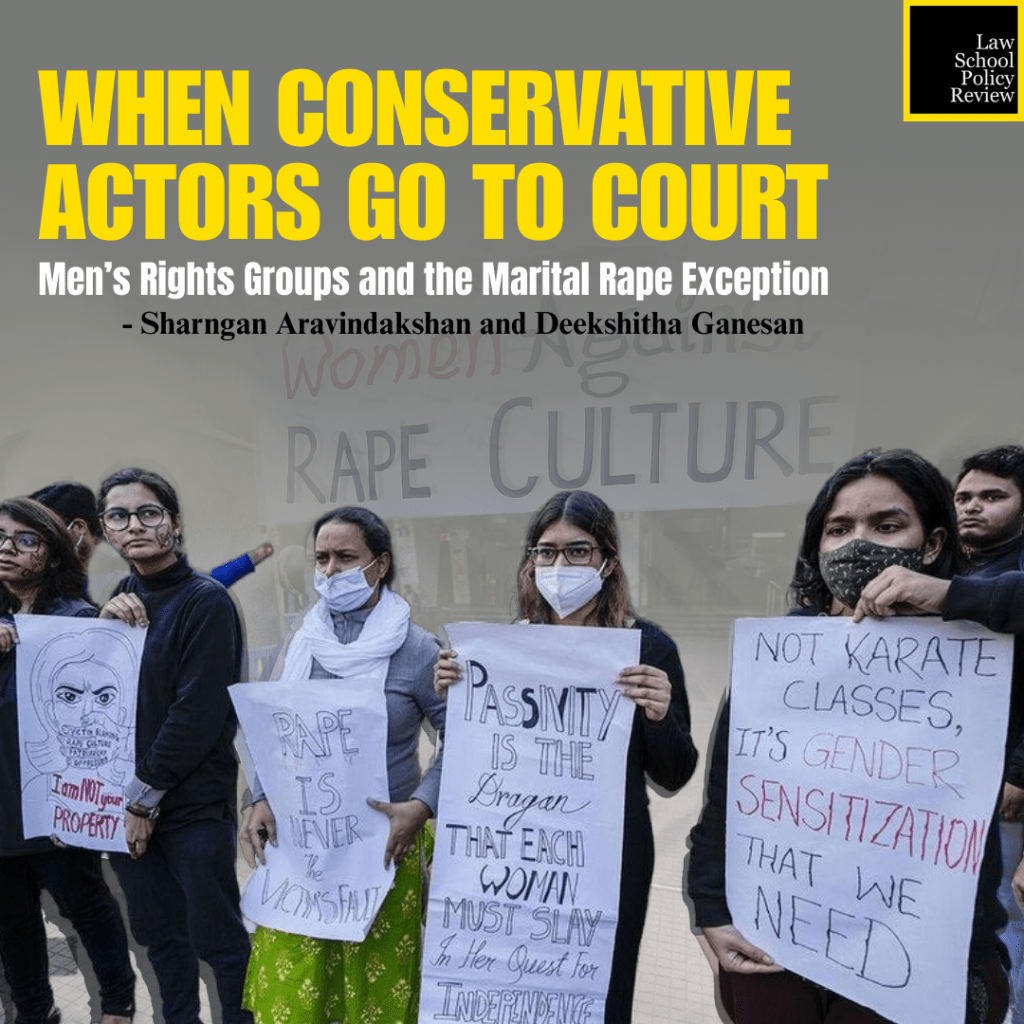
Abstract: This post examines conservative legal mobilisation in India to resist rights-expanding claims relating to gender and sexuality. While existing scholarship has largely emphasised autocratic legalism, this post shifts attention to conservative non-state actors who mobilise within constitutional litigation, typically PILs, to defend traditional social, religious, and familial norms. Drawing on the PIL challenging the marital rape exception, it explores the defining role played by men’s rights groups in the litigation, and analyses their legal and non-legal strategies and the arguments they advanced before the higher judiciary.
Introduction
The hearing of the constitutional challenge to the marital rape exception in the Indian Penal Code in RIT Foundation and Others v. Union of India and Others before the Delhi High Court saw the interventions of two groups, Men Welfare Trust and Hridaya-Nest of Family Harmony, to contest the petitioners’ arguments to strike down Exception 2 to Section 375. Part of a growing network of groups advocating for men’s rights, their arguments shaped the final verdict, with one judge of a panel of two upholding the exemption for marital rape and drawing from their arguments to do so.
In this piece, we explore the intervention of the men’s rights groups in RIT Foundation as part of a larger, global phenomenon that is yet understudied in India: the strategic use of courts by conservative non-state actors to defend or entrench traditional or conservative norms. While scholarship in India has examined “autocratic legalism” or the use of legal and constitutional change by populist leaders to advance illiberal agendas, lesser attention has been paid to how non-state actors may mobilise –sometimes independent of and at times aligned or converging with the Central government led by the Bharatiya Janata Party – to utilise legal tools and institutions to resist progressive change.
This piece looks at the role of men’s rights groups’ in RIT Foundation and Others v. Union of India and Others, their motivations to mobilise more broadly and specifically to intervene in this case, as well as the legal and non-legal strategies and arguments they employed, to illustrate how conservative legal mobilisation works in practice. Through a case-study of the litigation, we highlight the structural conditions that enable such mobilisation and the larger significance of such mobilisation.
We understand conservative legal mobilisation as the organised efforts of individuals, groups, or organisations with traditionalist or right-leaning ideologies to embody their values in positive law and its interpretation. While literature on legal mobilisation more broadly recognises a number of means and avenues for non-state actors to shape law, we restrict ourselves to court-centred legal mobilisation.
Contextualising Legal Mobilisation
A number of reasons have been advanced in the literature on legal mobilisation for when, why and how actors may turn to courts to obtain strategic outcomes. Actors may turn to courts when they lack access to political fora to achieve their objectives, or in other words, are “political outsiders” rather than “political insiders”. They may go to court either to secure long-term benefits since judicial decisions are perceived as difficult to dislodge, to protect benefits secured in alternative fora, or to preserve the status quo. They may also go to court to make themselves heard on an issue or to counterbalance the opposition’s dominance. The nature of a particular group’s cause or its characteristics can also cause it to turn to courts.
At the same time, legal systems have various features inherent to them termed as “legal opportunity structures”, that also shape actors’ choices and means of litigation. For instance, legal rules concerning access to justice, such as standing, are one example of legal opportunity structures. A key part of the legal opportunity structure for legal mobilisation in India is public interest litigation (PIL), with its broad standing rules and flexible procedures that allow for different kinds of actors to intervene and make themselves heard in court, enhancing the ability of non-state actors to use the courts to advance their goals.
To take advantage of legal opportunity structures, non-state actors additionally need access to legal expertise. The effectiveness of non-state actors’ mobilisation in Indian courts depends greatly on lawyers who use both their legal acumen as well as their reputational capital with judges, who are themselves often drawn from the legal profession, for securing favourable outcomes. Access to resources also matters for legal mobilisation in India, especially if actors have to sustain long-term litigation. That challenge can be overcome when lawyers offer their services pro bono.
In general, these considerations (legal opportunity structures, political insider-outsider distinctions, actors’ goals and access to legal expertise and resources) work in highly context-specific ways to influence non-state actors’ choices to litigate and the strategies they adopt in court. In the following sections, we demonstrate how, aided by the broad rules of intervention in PILs, men’s rights groups consolidated their goals and emerged as a cohesive voice in RIT Foundation, navigating their position as political outsiders holding a largely unpopular position, and accessing legal expertise that helped them develop legally sophisticated arguments that ultimately led to partial success before the Delhi High Court.
The Mobilisation of Men’s Rights Groups in India
Men’s rights groups were originally formed in India as a backlash to a series of legal reforms which included, among other things, addressing gender-based violence and dowry deaths. Members of these groups perceived these legal reforms as unfairly empowering women who weaponised them against their husbands and in-laws. For instance, members of men’s rights groups are particularly aggrieved by Section 498A of the Indian Penal Code 1860 that made “cruelty” to the wife by the husband or his relative an offence punishable with imprisonment. Accordingly, men’s rights groups’ demands include reforming Section 498A, besides others such as enhancing fathers’ rights for custody and ensuring protection for the husband’s relatives. Their collective cause is therefore at least partly a legal one and these groups represent a branch of an emergent conservative legal movement.
At the same time, men’s rights groups have also articulated men’s issues in terms of broader societal concern for the Indian family and society, which in turn reflects traditionalist or conservative values. For instance, ‘Save Indian Family Foundation’ (SIFF), a kind of umbrella group for men’s rights activists, has characterised husbands and in-laws as victims of unfair laws and, as the name also indicates, has framed their victimisation as part of an ongoing destruction of the ‘Indian family’ caused by ‘Western’ concepts like feminism. Overall, although men’s rights groups have rejected explicit political or religious affiliations, their goals and rhetoric often reflect conservative social views.
The Constitutional Challenge to the Marital Rape Exemption
Section 375 of the Indian Penal Code, which defines the crime of rape in India, exempts sexual acts by a man with his own wife through Exception 2. The marital rape exception’s (MRE) origins can be traced to 18th century notions of coverture, according to which wives’ legal identities merged with and were inferior to their husbands’. Although MRE in India is no longer justified in coverture terms, strong perceptions of the sanctity of the marital relationship and the fear that criminalising marital rape would lead to its misuse to harass husbands, have ensured that the MRE is still a major flashpoint in debates on criminal reform from a gender perspective.
In 2015, the constitutionality of the MRE was challenged in the Delhi High Court by women’s rights groups and an individual petitioner. In RIT Foundation and Others v. Union of India and Others, the petitioners had essentially argued that the MRE irrationally distinguished between rape by married and unmarried men, and that as a remnant of outdated coverture laws, the MRE violated women’s dignity in India protected by the right to life and personal liberty in Art. 21 of the Constitution. The petitioners also cited several international human rights instruments in support of their arguments, like CEDAW.
Resisting the challenge initially was the Central Government and the Delhi State Government. The two men’s rights groups, Men Welfare Trust (MWT) and Hridaya-A Nest of Family Harmony, subsequently intervened and argued that the case should be dismissed. While the Central Government initially contested the case, its counsel later informed the Court that “it did not wish to take a stand in the matter” and asked for the case to be deferred because the Central Government was undertaking stakeholder consultations on the MRE. The Court was no longer inclined to defer the case, having already done so on the government’s earlier request.
The government’s hesitation to defend the challenge meant that space was created for other actors to shape the narrative of resistance to the constitutional challenge. Effectively becoming the main opponents, MWT and Hridaya continued to actively litigate and raised numerous arguments supporting the MRE. In 2022, the Court issued a split verdict, with one judge holding that the MRE was unconstitutional and the other judge disagreeing, drawing from MWT’s and Hridaya’s arguments to support his reasoning.
A. Understanding Conservative Actors’ Choices to Litigate
Men’s rights groups’ broader mobilisation in India described briefly earlier in this piece help point to why MWT and Hridaya chose to intervene in RIT Foundation.
First, the nature of their cause makes them political outsiders as far as most representative fora are concerned. Men’s rights activists such as MWT’s president, Amit Lakhani, have acknowledged that mainstream political parties have expressed little support for them and their goal to roll back the laws they perceive as unfair to men. Wasif Ali, a co-founder of MWT observed in the context of the PIL against the MRE that “it is easier to stall new laws than to repeal the existing ones”. Therefore, when the PIL threatened husbands’ immunity under MRE, intervening in the case became a strategic way to defend the status quo.
Second, men’s rights groups in India appear to have developed some legal experience by supporting individuals combating legal cases filed by their wives and facilitating collaborative fora for this purpose. As its website indicates, MWT also closely tracks legal developments in family and other related laws, including judgements. This experience likely resulted in a certain level of familiarity with courts and legal procedures, that made it possible for them to consider intervening in the PIL.
Further, MWT’s impact in court visibly improved when they retained legal counsel. When MWT’s president initially failed to find a lawyer to represent MWT, he filed an intervention application himself, appeared in court as petitioner-in-person and successfully obtained the High Court’s leave to intervene. Later, they engaged prominent lawyer J. Sai Deepak, who has gained prominence as one of the significant conservative intellectual voices in India and appears to be an important emerging actor in the landscape of conservative legal mobilisation who makes conservative values and calls legally legible. Sai Deepak has indicated in interviews that his motivation for getting involved in the RIT Foundation case had been insufficient representation from the “other end of the spectrum”, signaling that he had intervened because of a need to counterbalance the perceived dominance of liberal feminist groups in the case.
Thus, men’s rights groups likely perceived courts as viable fora at least for retaining the status quo on their legal protections, since by invoking legal interests and rights, they can demand that their interests be accounted for. For lawyers with conservative goals, such groups can provide the vehicle for entry into court and contest progressive legal reform that they may perceive as endangering conservative ideals. The relatively loose intervention procedure in the Indian higher judiciary has also provided a fairly accessible legal opportunity structure for such groups to mobilise in court.
B. Strategies and Arguments Employed
Allying with legal counsel enhanced MWT’s legal argument in court, sharpening their courtroom strategy.
MWT’s initial submissions had focused on the misuse of pro-women laws against husbands and that there was implied consent for marital sex. Later, they evolved into technical and constitutional arguments that focused on how penal codes have always treated the marital institution as a separate class owing to the special relationship between a husband and wife. This argument sought to counter the petitioners’ argument that there was no rational basis for treating married and unmarried men differently for the crime of rape. MWT also argued that the court would be creating a new offence by striking down the MRE and that it lacked the institutional competence (vis-à-vis Parliament) to comprehensively account for the complex societal and legal consequences arising from such an offence.
An important procedural point that MWT stressed on was viewpoint diversity. They claimed that the court had to ensure adequate representation of diverse views. Since both amici agreed with the petitioners who wanted to advance women’s rights, MWT argued that the High Court should have also appointed another amicus with a “different view” for ensuring adequate representation. Hridaya and its counsel have generally supported these arguments in court.
Finally, the men’s rights groups also used cultural relativism to argue that the court ought not to rely on international human rights instruments relied on by the petitioners, since such instruments were “colonial” or westernized standards that do not reflect Indian social realities, particularly the cultural and religious significance of marriage in India.
These arguments largely found favor with one judge in a panel of two, who agreed that the “unique demographics” of marriage and the State’s legitimate interest in “protection of the marital institution” in India justified the legislature’s choice to not use the term “rape” in the marital context. The judge also agreed that the court was not the proper forum for the “creation of a new offence” such as marital rape.
Continued Mobilization and Convergence with the BJP-led Central Government
MWT’s legal mobilization extended beyond the Delhi High Court. It had also intervened in a similar PIL challenging the MRE in the Gujarat High Court, shortly before the Delhi High Court had issued its own verdict. MWT has now also approached the Supreme Court, after the petitioners’ appeal there from the Delhi High Court, to ensure its continuing involvement in the case and retain its secured outcome.
Men’s rights groups in India have explicitly disavowed any financial or ideological affiliation to mainstream political parties, including the BJP, out of frustration with them for “pandering” to women’s groups. But MWT’s arguments in the case nevertheless broadly aligned with the BJP government’s position in court. The BJP government’s stance on marital rape is evidently complex and evolving. This is indicated by their conspicuous change in position from initially contesting the PIL case to later seeking deferral of the case on the basis of consultations it was undertaking on the MRE. However, this did not mean that they supported the petitioners’ challenge either. For instance, despite a recent overhaul of criminal laws, the government has retained the MRE in Section 63 of the newly enacted Bharatiya Nyaya Sanhita 2023.
In this sense, MWT’s and Hridaya’s intervention in the case leading to the petitioners’ defeat may have allowed the BJP government to secure an outcome it agrees with while simultaneously avoiding the public endorsement of an exemption for marital rape. Currently in the Supreme Court, the BJP-led Central Government has taken the stand that the MRE should be retained, arguing that the court should defer to Parliament’s choice to retain the MRE and that its removal would lead to the misuse or abuse of rape penal provisions against husbands.
Conclusion
The RIT Foundation litigation illustrates that conservative legal mobilisation in India is increasingly structured and strategic, and an influential part of the country’s constitutional landscape. Such mobilisation reflects sophisticated strategies through which conservative non-state actors take advantage of liberalised rules of standing and the courts’ openness to hearing a wide range of actors, as well as employ rights-language and competing claims of representation to contest progressive legal change.
Although matters concerning gender and sexuality have long been litigated in India, examining the role played by conservative non-state actors in court is relatively new. Case records and interactions in court reveal only so much about the motivations of such actors for going to court, since their intentions and agenda are typically transformed into formal legal language. More and different kinds of qualitative research is required for greater interrogation of conservative non-state actors’ choices to litigate, their perception of their roles and the strategies they deploy, how litigation itself becomes a site for coalition building, the emergence of legal actors who translate conservative values into constitutionally legible claims, and how the goals of state and non-state actors may converge (or diverge), so as to obtain richer insights into conservative legal mobilisation to challenge progress on gender-based and sexual rights in India.guarantees.
Sharngan Aravindakshan is a PhD Candidate at Tilburg Law School where he researches strategic litigation and the evolving role of courts in achieving social change.
Deekshitha Ganesan is a lawyer and works for a transgender rights organisation in Berlin.
Categories: Legislation and Government Policy
 Law School Policy Review