
*Anshul Ramesh & Namit Halakhandi
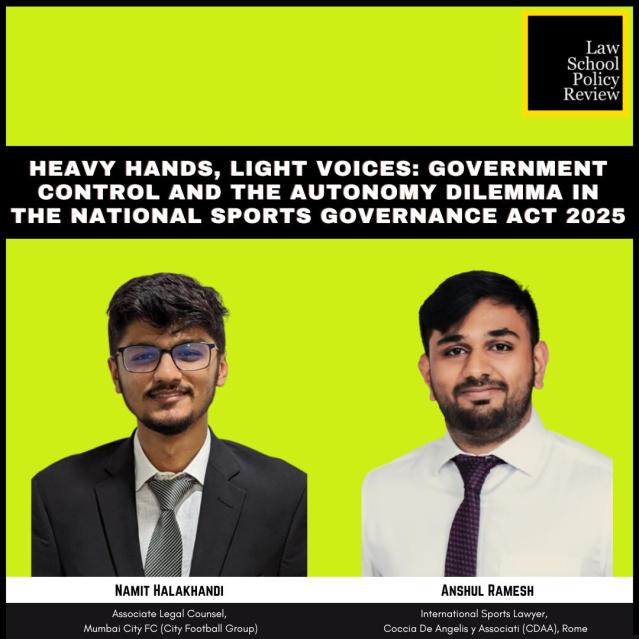
This paper analyses India’s National Sports Governance Act, 2025, examining how its centralized governmental control over sports federations conflicts with international autonomy requirements. Drawing from FIFA’s 2022 suspension of Indian football, it demonstrates risks of international sanctions and proposes the UK’s conditional funding model as an alternative approach balancing reform with federation independence.
Introduction
The passage of the National Sports Governance Act, 2025 (“NSGA”) on 18 August 2025 represents a watershed moment for Indian sport. For the first time, the governance of federations, dispute resolution, and ethical safeguards have been codified in statute rather than left to ministerial codes or ad hoc directives (found previously under the National Sports Development Code of 2011). On paper, the NSGA seeks to professionalise administration, protect athletes, and align India with international governance norms. That said, beneath these reforms lies a deeper tension: the sweeping powers vested in the Central Government, from appointments to oversight and funding. This raises an uncomfortable question as to whether India can achieve cleaner governance without eroding the autonomy of National Sports Federations (“NSFs”), a principle fiercely guarded by the Olympic and Paralympic Charters.The answer will determine whether the NSGA can be deemed a true instrument of reform or another flashpoint in the long-standing debate over state control in Indian sport.
Through this article, the authors attempt to answer this question by first dissecting the NSGA with respect to its provisions on centralised control and then analysing its implications on the autonomy and independence of NSFs.
Extent of Governmental Influence Under The NSGA
Under the NSGA, the Central Government appears to play a pivotal role in the governance of Indian sport. As a starting point, the Central Government is in charge of establishing the National Sports Board (“NSB”) and appointing its Chairperson and members as well as other staff members. Although the NSGA prescribes qualifications such as expertise in areas like sports governance, law, or administration that are to be met by candidates, the appointment process (as well as decisions with regard to salaries, tenure, and removal of such members) is ultimately driven by the Central Government through a search-cum-selection committee. In this respect, it must be noted that the NSB plays the crucial function of granting, suspending and even cancelling Board recognition to NSFs – which in turn determines an NSF’s eligibility to receive financial aid from the Central Government. Moreover, the NSB is also empowered with conducting inquiries into an NSF’s affairs and even constituting an ad hoc administrative body to administer the NSFs in certain cases. This financial dependence, coupled with the wide powers of the NSB to intervene, could result in reluctance of NSFs to challenge or oppose members of the NSB. This dependence raises concerns about their autonomy.
In relation to elections of the NSFs, the NSGA entrusts the Central Government, acting on the recommendation of the NSB (also appointed by the Central Government, see supra), with the responsibility of notifying the National Sports Election Panel (“NSEP”), whose members (retired election officials) are tasked with overseeing elections to the Executive and Athletes Committees of NSFs, and their affiliates. While the use of experienced election officers to ensure fairness and credibility is a common phenomenon in the Indian framework, the fact that the Central Government ultimately constitutes members of the NSEP means that even electoral processes within sports federations remain closely tied to government approval. This concentration of control is problematic because when the same authority that funds and regulates NSFs also oversees their elections, it creates clear risks of bias and lack of accountability. Indian sport has already witnessed several incidents where such a mechanism results in unnecessary interference and more often than not entrenching existing power structures (e.g. Indian Olympic Association’s interference in elections of the Indian Golf Union). In fact, given that disputes surrounding elections have been a recurring theme in Indian sports, entrusting the process almost entirely to the Central Government might not be the most effective solution. Therefore, although well-intentioned, this structure could still invite concerns about the fairness of such elections and the degree of independence enjoyed by NSFs to manage its own affairs.
The creation of the National Sports Tribunal (“Tribunal”) is projected as a step towards independent and specialised dispute resolution for sports. However, the appointment process underscores the weight of governmental control. In particular, the Tribunal is to be constituted by the Central Government, with its Chairperson and members appointed on the recommendation of a search-cum-selection committee, which consists of the Chief Justice of India (or a Supreme Court Judge nominated by him) as Chairperson, the Secretary to the Government of India in the Ministry of Law and Justice, and the Secretary to the Government of India in the Department of Sports, as its members. While the presence of the Chief Justice of India (or a nominated Supreme Court Judge) as Chair of this committee lends necessary judicial oversight, the other two members of this committee are actually government officials. This composition effectively gives the Central Government a majority in the selection process and, in practice, may compromise the Tribunal’s perceived independence.
Lastly, the NSGA grants the Central Government extensive powers to issue regulations, direct the NSB, relax eligibility criteria, and even exempt certain sports bodies from provisions of the NSGA. Similarly, the government may also impose restrictions on national teams or individuals in extraordinary circumstances, including matters of national security, public order, or safety. While such powers may be seen as necessary, they reinforce the centralised control of the state over sports governance.
Implications of governmental influence on the independence and autonomy of NSFs
Having highlighted the extensive reach of the Central Government under the NSGA, it is essential to examine the implications of such influence on the independence and autonomy of NSFs. To do so, it is important first to underscore the principles of autonomy and independence as recognised within the international sporting framework.
The principle of autonomy in sports governance is not simply a preference or an option, but one of the core tenets of global sports governance. Article 27 of the Olympic Charter states that:
“The NOCs must preserve their autonomy and resist all pressures of any kind, including but not limited to political, legal, religious or economic pressures which may prevent them from complying with the Olympic Charter.”
In the same vein, Article 15(c) of the FIFA Statutes states that all:
“Member associations’ statutes must comply with the principles of good governance, and shall in particular contain, at a minimum, make provisions relating to the independence of the member association and avoidance of any form of political interference”.
Furthermore, the FIFA Statutes and the Asian Football Confederation Statutes require member associations to manage their affairs independently and without influence from any third parties in their decision-making.
In fact, such requirements are not limited to football. Comparable provisions exist in other sports as well, such as basketball and cricket – where the FIBA General Statutes expressly mandate that “National member federations shall manage their affairs independently and with no influence from third parties”, while the ICC Articles of Association require members to “manage their affairs autonomously and ensure that there is no government (or other public or quasi-public body) interference in their governance, regulation and/or administration of Cricket”.
Moreover, sports federations operate under a system of self-regulation and self-autonomy through a body of jurisprudence and private rules called “lex sportiva”, which is believed to be better equipped to handle the unique nature and complexities of sporting challenges that national legal systems might not address, and to bring harmony across different jurisdictions. Accordingly, these principles form the very foundation of the relationship between international federations and their national members. In most cases, compliance with these principles is a prerequisite for participation in international competitions.
There have been multiple cases where international federations have suspended member federations when their autonomy or independence is infringed, such as during government or third-party interference. For example, in August 2022, FIFA suspended the All-Indian Football Federation (“AIFF”) “due to undue third-party interference“. This was after a court-appointed committee took control of its administrative affairs. While the court-appointed committee i.e. the Committee of Administrators (“CoA”) was intended to resolve administrative deadlock, FIFA regarded it as a violation of the requirement that a federation should be managed by its elected representatives without external involvement. The immediate consequences: India temporarily lost its hosting rights for the FIFA U-17 Women’s World Cup 2022, and its national teams and clubs risked exclusion from international confederation competitions. The suspension was lifted only later that month, once the CoA stepped aside and elections were conducted under a framework acceptable to FIFA.
This highlights the stance of international federations against even judicially formed interim administrative bodies. This is not an isolated story – FIFA has issued similar suspensions to several other national football federations over the years such as Nigeria (2014), Kuwait (2015–2017), Iraq (2008), and Guatemala (2016). All of these were due to direct or indirect government interference, with participation bans only lifted once autonomy was restored.
These examples illustrate that international federations treat any form of political or judicial intervention as incompatible with their statutes, even when national authorities act in good faith or in public interest. The broader point remains that autonomy is not typically a negotiable principle but a strict condition for participation in international competitions.
The recent standoff between FIFA and the AIFF in 2025 serves as a cautionary tale of what lies ahead if the NSGA is implemented without recalibration. This illustrates that international federations rarely distinguish between judicial, legislative, or executive involvement and all such interventions are read as infringements on autonomy.
Given that Indian sporting bodies have frequently faced controversies – particularly regarding elections of such bodies –, allowing the Central Government to appoint members to principal organs (such as the NSB, NSEP, and the Tribunal), as well as to constitute ad hoc administrative bodies, seems to disregard how similar interventions have previously triggered international sanctions. By enshrining such powers in law, the relevant provisions in the NSGA could place India at tangible risk of suspension or derecognition on the global stage in cases of disputes raised relating to the Central Government’s exercise of such powers.
By codifying wide state powers into law, the NSGA risks normalising precisely the kind of interventions that have triggered sanctions in the past. Unless the government can strike a balance in the implementation of the NSGA that preserves transparency and accountability while protecting the autonomy demanded by international statutes, India’s sporting bodies might remain exposed to repeated cycles of global censure and exclusion.
Conclusion
While the NSGA seeks to strengthen sports governance and align India with international norms, its provisions concentrating powers in the hands of the Central Government raise serious questions about the autonomy of the NSFs. By vesting extensive powers over appointments, oversight, elections, and regulatory authority, the NSGA risks replicating the very forms of interference that international federations have historically sanctioned. Moreover, given that sports is a “state” subject under the Constitution, the Central Government’s legislative reach – and consequently its extensive influence – may itself be constitutionally debatable. This tension underscores the delicate balance the NSGA must strike between reforming governance and preserving the independence of sporting bodies: a balance that will ultimately determine whether the NSGA strengthens or undermines the credibility of Indian sport both nationally and on the global stage.
To this end, the authors suggest seeking inspiration from other countries such as the United Kingdom (“UK”), where sports governance has been strengthened without resorting to binding centralised legislation. Instead of forcing control through binding legislation, the UK has put in place a “Code for Sports Governance”. This code links public funding directly to how well sports organisations follow governance standards. Any sporting organisation that seeks to get funding from UK Sport or Sport England must demonstrate adherence to the principles of transparency, accountability, and independence; with a tiered framework ensuring that higher levels of funding attract more rigorous requirements, while smaller organisations face proportionately lighter obligations. This approach incentivises reform by making good governance a condition for financial support, thereby balancing oversight with autonomy. It provides federations with strong incentives to professionalise without direct state interference, while still letting them manage their own internal affairs.
For India, the UK model provides an interesting and working alternative to the centralised model of the NSGA, evidencing that India too can achieve reform through cooperation and conditional funding, rather than through direct government intervention. Adopting similar principles when implementing the NSGA could help the government encourage professionalism and transparency while respecting the autonomy that international federations require under their statutes and/or regulations.
Author’s note – The SCs decision to subject future AIFF constitution amendments to its prior approval is the latest example of federation autonomy being infringed upon, and it’ll be a waiting game to see if FIFA will deem this as third party interference.
*Anshul Ramesh is an international sports lawyer at Coccia De Angelis y Associati (CDAA) in Rome, specialising in sports arbitration, dispute resolution, and commercial matters. He has extensive experience in sports and corporate law, having worked with leading law firms and international institutions. Beyond practice, he contributes regularly to leading sports law blogs and journals, and is frequently invited to speak at conferences and deliver lectures on sports law.
*Namit Halakhandi is Associate Legal Counsel at Mumbai City FC (City Football Group), specialising in commercial, regulatory, and dispute resolution matters. He has international experience in sports arbitration and governance and is actively involved in mentoring aspiring sports law professionals and athletes.
Categories: Legislation and Government Policy
 Law School Policy Review