
*Mahit Anand & Amrut Joshi
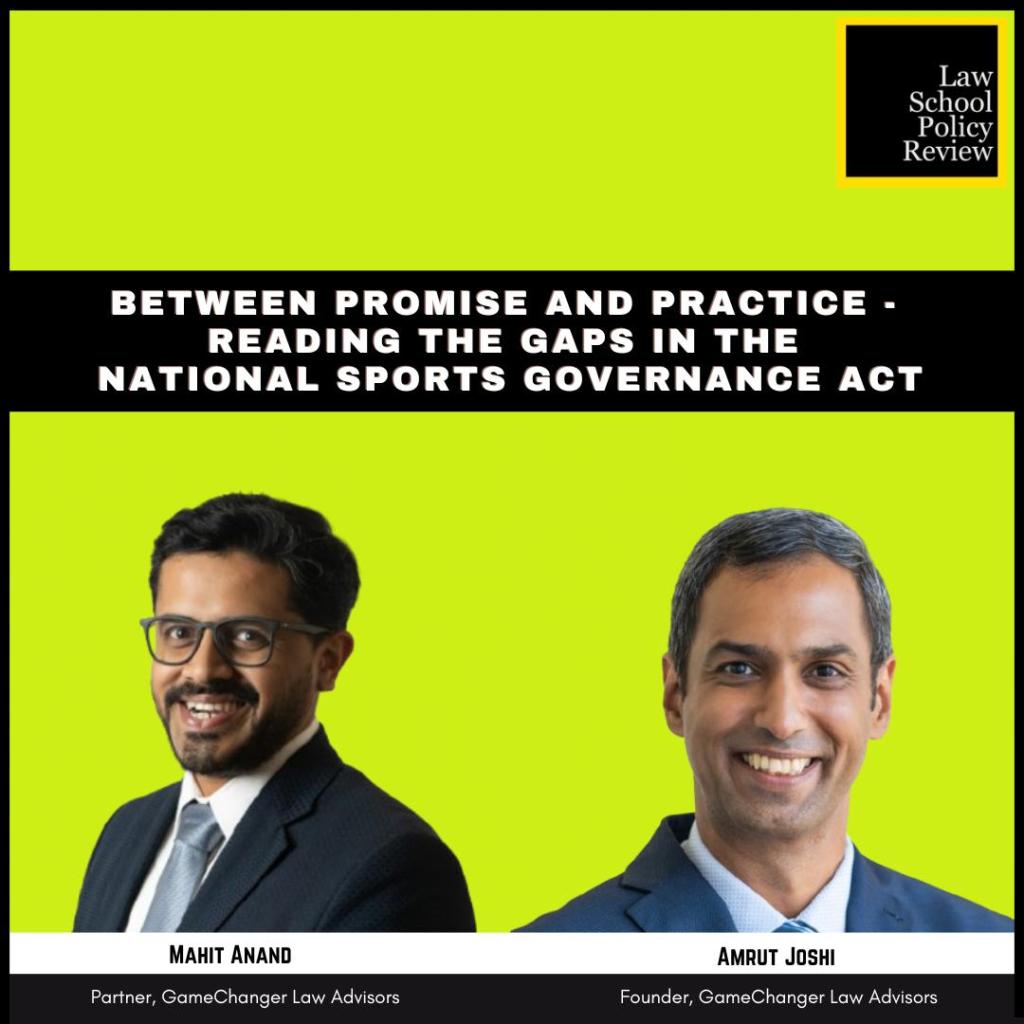
The National Sports Governance Act, 2025 introduces transformative reforms for India’s sporting ecosystem, yet key issues around institutional powers, enforceability, and accountability remain unresolved. This article critically examines these gaps, highlighting challenges in translating legislative intent into effective, transparent, and fair governance for athletes and federations.
Introduction
The passage of the National Sports Governance Act, 2025 (“NSGA” or “Act”) has been widely hailed as a historic step toward reforming India’s sporting ecosystem. For decades, the country’s sports administration has been marked by opaque decision- making, entrenched hierarchies, and recurrent scandals—ranging from conflicts of interest and governance lapses to harassment and mismanagement. The Act promised to deliver transparency, accountability, and statutory safeguards for athletes, while creating institutional mechanisms aimed at standardising governance across federations. On paper, it appeared to signal the arrival of a modern, structured framework, moving beyond ad hoc guidelines and judicially driven interventions.
Yet a closer examination reveals that the NSGA, while ambitious in design, leaves critical questions unanswered. Passed with minimal debate, the law establishes new institutions like the National Sports Board and the National Sports Tribunal, and mandates policies such as the Safe Sports Policy, but stops short of detailing powers, enforcement mechanisms, or operational independence. The Act’s silence on issues of fan safety, governance oversight, and applicability to cricket’s most influential body, the BCCI, raises doubts about whether it can achieve the transformative change it promises.
This article undertakes a critical examination of the National Sports Governance Act, 2025, by exploring its institutional framework and practical implications across four key dimensions. First, it analyses the scope and structure of the newly established National Sports Board, assessing both its potential to unify governance standards across federations and the concerns around its composition and enforceability. The discussion then turns to the inclusion of the Board of Control for Cricket in India (BCCI) within the Act’s framework, noting the nuances and complexities involved. The article also evaluates the aspirations behind the Safe Sports Policy, while pointing to gaps in enforceability and comprehensiveness. Finally, the discussion turns to the National Sports Tribunal, examining its design, operational ambiguities, and the broader accountability gaps arising from the Act’s extensive delegation of rule-making powers. By critically exploring these issues, the article aims to provide a thoughtful perspective on the gap between the NSGA’s reformative promise and the practical realities of implementation.
The National Sports Board under the NSGA: Scope, Structure, and Challenges
At the core of the NSGA lies the National Sports Board (‘NSB’), envisioned as a central regulatory authority with sweeping responsibilities: recognizing sports federations, overseeing internal governance, monitoring elections, and safeguarding athlete welfare nationwide. This institutional innovation is intended to address India’s long- standing fragmentation in sports administration, creating a central node of accountability and oversight. By mandating uniform governance standards and ensuring federations adhere to transparent procedures, the NSB represents a significant structural shift.
However, while its ambitions are clear, the law provides limited detail on how these powers will be exercised. The NSB may issue directions to federations, yet the enforceability of these directions remains undefined, as do the criteria for recognising or de-recognising federations. The Board’s composition favours government nominees, offering limited scope for independent experts or athlete representation. This imbalance risks undermining both credibility and efficacy, as the body is expected to regulate entities it may be structurally aligned with, creating an inherent conflict between oversight and collaboration. The NSB’s role, therefore, while conceptually promising, risks becoming symbolic without mechanisms to ensure accountability and independence.
BCCI and the Act: The Elephant in the Room
No discussion of Indian sports can ignore the Board of Control for Cricket in India (‘BCCI’), which dominates the country’s sporting economy, media attention, and sponsorship landscape. Despite its de facto status, the BCCI has long resisted statutory oversight, relying instead on self-regulation and judicial interventions. The Supreme Court’s landmark decision in Board of Control for Cricket in India v. Cricket Association of Bihar (2016) sought to bring the Board within the ambit of constitutional accountability. The Court endorsed the Lodha Committee’s recommendations for structural reforms, ranging from cooling-off periods for office bearers to transparency in administration. Yet, the entrenched autonomy of the BCCI within India’s sporting order looms large.
The NSGA appears to bring cricket firmly within its regulatory ambit. Section 3 of the Act recognizes that every designated sport must have a national federation, which by default includes the BCCI. However, Section 34 of the NSGA provides a narrow exemption route, allowing the government to exclude a body only in consultation with the International Cricket Council and the National Sports Board, and strictly in the public interest. While this framework seems to close longstanding regulatory gaps, the exemption clause introduces ambiguity and the potential for selective application, leaving the door open for challenges or delays in implementation. The Act, therefore, signals a shift toward inclusivity and oversight, but the BCCI’s historic dominance and global influence suggest that statutory control may still face practical hurdles.
Safe Sport: Aspirations Without Teeth
The NSGA’s introduction of a Safe Sports Policy marks an important acknowledgment of the duty of care owed by sports federations, extending beyond athletes to encompass the wider sporting ecosystem. Statutorily, the Act requires such policies to safeguard women, minors, and other identified persons, with an emphasis on the prevention of harassment and abuse. While this formulation is a welcome recognition of systemic vulnerabilities, its restricted focus on certain categories of persons leaves ambiguity as to whether the Safe Sports Policy is intended to address broader safety concerns—such as crowd management, infrastructural risks, and the welfare of coaches and staff—that have historically exposed fault lines in Indian sport.
The recent tragedy at Bengaluru’s Chinnaswamy Stadium during RCB’s victory parade—where inadequate permissions, poor communication, and lack of preparedness led to fatalities and injuries—stands as a stark reminder of how lapses in planning and accountability can quickly spiral into disaster.
Yet, while the mandate is progressive in principle, the law provides little guidance on implementation. There are no prescribed standards for reporting, investigating, or remediating violations, and no clear delineation of whether oversight falls to the NSB, the Tribunal, or the Ministry. Athletes, while central to the policy’s purpose, are not explicitly included in its governance or monitoring structures. Critical dimensions of safety—intersectional vulnerabilities, emergency preparedness, and fan protection— remain largely unaddressed. As a result, the Safe Sports Policy risks becoming more symbolic than operational. Its ultimate impact will depend heavily on the quality of rules drafted by the government and the institutional capacity to enforce them. Without these mechanisms, the policy could fall short of the transformative effect it promises.
The National Sports Tribunal: Promise and Pitfalls
To address disputes in sport, the Act establishes a National Sports Tribunal (‘NST’), designed to provide a quasi-judicial forum for athlete grievances, governance disputes, and challenges to federation decisions. Conceptually, this tribunal aims to streamline dispute resolution, reduce dependence on courts, and foster confidence in governance processes.
However, as with other components of the NSGA, details on the NST’s operation remain vague. The Act recognises the exclusive jurisdiction of the Court of Arbitration for Sport (CAS), which raises uncertainty about the NST’s role in disputes that fall within CAS’s remit. Appointments are controlled by the executive, which may compromise perceived independence. Mirroring the broader landscape of Indian regulatory dispute resolution, the track record of sectoral tribunals has been decidedly mixed. Despite the proliferation of tribunals such as the Securities Appellate Tribunal and the Telecom Disputes Settlement Tribunal, their effectiveness has often hinged on the quality and adequacy of staffing and resources. Periods of robust administration have seen reduced backlogs and more timely outcomes; yet, inconsistent investment or lack of expertise has led to significant delays, undermining confidence in these mechanisms as alternatives to the courts. The sustainability and credibility of the NST, therefore, are likely to depend far more on the calibre of its personnel and a genuine commitment to fairness than on statutory design alone.
Furthermore, the Act allows appeals to High Courts, which, while necessary for checks and balances, may reduce the Tribunal’s ability to provide speedy and final resolutions.
The Tribunal’s potential effectiveness, therefore, hinges on structural independence, adequate judicial and technical staffing, and procedural clarity. Without these, the NST may struggle to meet expectations, undermining one of the Act’s core promises.
Rules, Delegation, and the Accountability Gap
A notable aspect of the NSGA is its extensive delegation of substantive governance decisions to executive-issued Rules. Pivotal issues—such as the recognition of sports federations, the formulation of Safe Sports Policy standards, and procedural frameworks for the National Sports Tribunal—are left to government notifications. While delegation of legislative authority is a familiar feature in regulatory regimes, over-reliance on it can undermine transparency, accountability, and predictability for both federations and athletes.
By entrusting such fundamental matters to bureaucratic discretion, the Act risks establishing a governance framework in which the practical contours of regulation are shaped more by administrative rules than by the statutory text itself. This raises significant constitutional and democratic concerns regarding the separation of powers and the propriety of excessive legislative delegation, exposing the gap between legislative intent and on-the-ground implementation.
This delegation-driven framework also exacerbates the accountability gap, as it diffuses responsibility among executive agencies and dilutes direct parliamentary oversight. Critical governance outcomes hinge on administrative discretion rather than clear legislative mandates, creating potential inconsistencies and uneven application of rules across federations and stakeholders. Moreover, this opacity in decision-making risks eroding the very trust and legitimacy necessary for effective sports governance, as affected parties—particularly athletes—may find it challenging to seek redress or clarity when key processes lack statutory anchoring. For governance reform to be substantive rather than symbolic, the Act must be complemented by clear mandates for participatory rule-making, independent oversight mechanisms, and enforceable accountability standards to safeguard the rights and interests the legislation professes to protect.
Conclusion: From Promise to Practice
The National Sports Governance Act, 2025, embodies a mix of promise and uncertainty. It represents India’s first attempt to codify sports governance, and introduces mechanisms intended to enhance transparency, athlete welfare, and dispute resolution. The creation of the National Sports Board, the Safe Sports Policy, and the National Sports Tribunal demonstrates legislative intent to modernize the system.
Yet, the Act leaves many critical questions unresolved. The NSB’s powers and independence are ambiguously defined; the BCCI, while nominally included, could leverage exemptions or practical influence to resist reforms; the Safe Sports Policy lacks enforceable standards; and the Tribunal’s success depends on staffing, structural design, and procedural clarity. Furthermore, the reliance on Rules to fill substantive gaps shifts accountability away from Parliament and onto the executive.
The Act’s ultimate success will depend not on its passage, but on how these institutions and policies are implemented. For India’s athletes, federations, and sporting ecosystem, the challenge lies in translating statutory intent into operational reality. Unless these gaps are addressed with clarity, independence, and enforceability, the NSGA risks being remembered not as a transformative law, but as an ambitious framework whose promise exceeds its practice
*Mahit Anand is a Partner at GameChanger Law Advisors with over a decade of experience in General Corporate Advisory, Commercial Contracts, Sports Law, and Social Enterprises Law. He advises clients across technology, education, healthcare, sports, and social impact sectors, handling mergers, acquisitions, and venture capital investments. Mahit read law at the School of Law, Christ University, Bengaluru and graduated with a B.A. LLB degree in 2014.
*Amrut Joshi founded GameChanger Law Advisors in 2011. He has been recognized as an expert corporate and commercial lawyer, sought after by leading startups, venture capital firms, consulting firms, impact investors, angel investors, and sportspersons across the world. Amrut’s articles on various legal issues have been published both nationally and internationally. He has also been invited to share his insights on reputed television channels and digital platforms. Amrut read law at the National Law School of India University, Bengaluru and graduated with a B.A. LLB (Hons.) degree in 2003.
Categories: Legislation and Government Policy
 Law School Policy Review