
Ashish Chauhan*
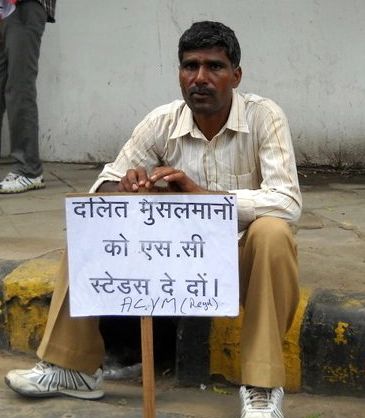
(Source: KAFILA – COLLECTIVE EXPLORATIONS SINCE 2006
There has been a persistent tendency in Courts to confine the concept of caste strictly within the Hindu religious framework, despite significant sociological evidence demonstrating the presence of caste-based hierarchies across religious communities in India. This failure to acknowledge caste beyond Hinduism primarily stems from an uncritical reliance on colonial-era ethnographic models, which constructed caste as a uniquely Hindu phenomenon. This limited judicial understanding does little to correct the systemic exclusion of groups, like Dalit Christians and Muslims, who situated at the intersection of two marginalized identities, namely caste and religion. Consequently, they remain outside the scope of constitutional affirmative action and are denied the protections afforded under legislations such as the Scheduled Castes and Scheduled Tribes (Prevention of Atrocities) Act. The article critically evaluates the legal and constitutional justifications of this exclusion and argues that such reasoning is inadequate and incompatible with contemporary understandings of caste-based discrimination.
(A realist outlook showcases caste’s inter-religious existence, which is manifested in discrimination in social settings and employment opportunities. Courts, however, have been reluctant to adopt this view due to legal formalism. Through this piece, the author critiques the recent judgment in Akkala Rami Reddy vs State of Andhra Pradesh, calling for an inclusive and realist assessment of caste.)
“Jahva se aayo amar wah desva
Pani na paan dharti akasva, chand na soor na ren diwasva
Brahman chhatri na sudra baiswa, mughal, pathan na syed sekhwa”
-Saint Kabirdas
Unlike his contemporaries, Kabir extends the ‘question of caste’ to both Hindus and Muslims through his writings. This recognition of caste across religions is revolutionary, as subsequent orientalist-colonial religionisation of caste restricted it merely to a Hindu phenomenon. The oriental view was reified through the pre-independence law-making and has been inherited for modern governance from the colonial State, especially in foundational discourse, law and order, and its analogous institutions, the legal and penal systems. Resultingly, the courts have also remained stuck in legal formalism and have overlooked the impact of caste transcending religious contours. The recent Andhra Pradesh High Court judgement in the case of Akkala Rami Reddy v. State of Andhra Pradesh is a stark reminder of the necessity of decolonisation of law in reality, along with a demand for the courts to look beyond the form and identify violations of fundamental rights through a realist lens. This article is an effort to interrogate the persistence of caste beyond Hinduism through the application of legal realism. The author observes the exclusionary framework of the Scheduled Castes and Scheduled Tribes (Prevention of Atrocities) Act, 1989. Through the evaluation of historical and ongoing reform efforts, inclusive legal reforms to address systemic marginalisation are advocated.
Brief Background of the Case
The existing juridical approach solidifies caste predominantly as a religious institution. It ignores the caste’s socio-economic dimensions (materiality) across Muslim and Christian communities and dismisses empirical evidence of caste-based discrimination in non-Hindu contexts, such as Pasmanda exclusion from Ashraf-dominated institutions or Dalit Christian marginalisation in social spaces like the cemetery.
In Akkala Rami Reddy v. State of Andhra Pradesh, the Andhra Pradesh High Court quashed a case against petitioners accused of offences under the SC/ST (Prevention of Atrocities) Act, 1989. A Christian pastor had filed a complaint, alleging that he received abusive phone calls targeting his caste and threatening his life. Against this, the petitioners argued that the pastor, having converted to Christianity, could not claim SC status under the Constitution (Scheduled Castes) Order, 1950, thereby making the SC/ST Act inapplicable. The pastor, however, claimed SC (Madiga) status, evidenced by a caste certificate. The Court, here, ruled that the respondent’s Christian status disqualified him from SC/ST Act protections, quashing the case as an abuse of process. It also held that mere non-cancellation of the caste certificate by the authority to a person who has converted into Christianity cannot instil the protection granted under the protective legislation.
The Exclusionary Framework of the SC/ST Act: Definitional limitations.
The Scheduled Castes and Scheduled Tribes (Prevention of Atrocities) Act, 1989 (hereinafter SC/ST Act) was a positive development in India’s legislative scheme for protecting marginalised groups from violence and discrimination on the basis of caste, making it the first legislation focusing on caste as a relational process (with the privileged castes). However, as evidenced in the Akkala Rami Reddy case, such protection is not extended to Dalit converts, as the root of the problem lies in the definition of the Scheduled Caste in the SC/ST Act.
The preamble to the Act defines it as a “protective statute” intended to “prevent the commission of offences of atrocities against members of the Scheduled Castes and Scheduled Tribes”. Section 2(c) of the Act refers to Scheduled Castes (SCs) and Scheduled Tribes (STs), which are officially defined under clauses 24 and 25 of Article 366 of the Constitution of India. Castes are designated as SC by virtue of Article 341, which empowers the President to specify castes, races, or tribes as SCs through a public notification, formalised by the Constitution (Scheduled Castes) Order, 1950.
Now, this order becomes the bone of contention. By providing SC status only to Dalits following Hinduism, Sikhism, or Buddhism, the same is effectively denied to Dalit converts to Christianity and Islam. Here it would be essential to recall that social harms stemming from untouchability has been the basis for the creation of the category of SC. The Registrar General of India relying on the absence of untouchability in theological texts of Christianity and Islam, therefore justifies limiting of the category’s expansion.Such deterministic reasoning indirectly posits religious conversion as an instantaneous remedy for caste-based marginalisation. However, this rationale oversimplifies the existence of caste as a material structure of inequality, neglecting the socio-economic realities of Dalit Christians and Muslims. The caste status lingers upon even after conversion and is not neutralised by the mere act.
Uncritical reasoning of exclusion and the enduring materiality of caste across religious boundaries.
The exclusion of Dalits converting to Islam or Christianity is based on the assumption that untouchability, a characteristic criterion for SC designation, does not exist in Christianity and Islam. Their egalitarian theological structures wipe out caste identity and its accompanying socio-economic disadvantages, and that conversion to these religions essentially renders protective legislation unnecessary. Such an argument assumes a causal, linear connection between religious conversion and the end of caste-based exclusion, assuming conversion as an instantaneous corrective measure. This argument, however, is flawed in that it overestimates the nature of caste as a Hindu-social institution and underestimates its cross-religion endurance.
Contrary to the view proposed by the Orientalists, caste is a dynamic relational order that shapes power structures and socio-economic conditions. Thus, placing it as a religious institution and regarding conversion as an anecdote for caste-based discrimination does not account for the material aspect of the same. Caste’s materiality causes social stigmatisation, economic exclusion and institutional discrimination, which conversion cannot improve. For example, Christians themselves recognise that Dalit Christians face discrimination in socio-religious spheres like cemeteries as well as in institutions, which is reflected by the denial of leadership positions. Similarly, Ashraf and Ajlaf/Arzal (covering Pasmanda groups) showcase caste-like differences that include untouchability. The tangible impact of caste in these communities can be seen through the highly unequal distribution of group resources and their social standing. As an example, 80% of Dalit Muslims are landless, whereas the share of Upper Caste Muslims is 44%. Furthermore, caste also shapes the economic reality of Dalit Christians and Muslims, relegating them to low-grade, unsecured work. The gatekeeper role played by the kinship-based system assures the monopoly of the privileged on the resources. To illustrate, Halalkhor Muslims are significantly poorer than their counterparts, and are also engaged in lower-status jobs like sanitation. This continued economic segregation underlines the caste’s exclusionary nature, transgressing religious lines.
It is the malleable nature of caste that permits its infestation into the perceived egalitarian religions. Similar to Mark Fisher’s depiction of capitalism’s plasticity, plasticity enables caste to adapt and survive across religious boundaries, leaving textual egalitarianism ineffectual against its material reality and subsuming the theological structures within the Indian caste-based social order. The inclusion of Sikh and Buddhist Dalits in the SC list despite their religions’ anti-caste origins underscores the triumph of caste’s relational processes over religion’s doctrinal egalitarianism, having an impact on the lived reality. Thus, if Sikhs and Buddhists have been afforded protection under the SC list, there is no reason to continue separating Dalits converting to Christianity and Islam.
The illusion of problems: untenable justification for non-expansion
Broadly, three problems have been stated by the RGI and other constitutional bodies like the National Commission for Scheduled Castes while extending the SC status to Dalit Christians and Muslims. These include the problem of swelling up of the SC category, the absence of a single ethnic group between the converted Dalits and the possibility of increased conversion to Islam and Christianity after the extension of the quota.
Firstly, the swelling of the SC category is problematised by the RGI as this would result in the dilution of the affirmative action benefits that are enjoyed by the already covered population. This claim, however, fails to provide a reasonable justification for not providing SC status to Dalit converts. The quantum of reservation was decided based on several factors, including the share of the SC community’s population. In Indira Swahney v. Union of India, the Supreme Court itself acknowledges proportion as an important yardstick to decide the quantum of reservation, if not the predominant factor. Therefore, by adjusting the quantum to the newer population share, more so after the Central government’s approval of the ‘caste census’, the problem of underrepresentation of existing sub-castes within SC can be treated.
Although the spectre of ‘merit’ might linger around, and Indira Swahney’s 50% limit might be stressed upon if the quantum is expanded. The notion of merit must then be challenged to make it more inclusive and not hamper the transformative capacity of the constitution. Also, the Court recognises that the 50% limit can be exceeded if extraordinary circumstances exist, especially with communities that lie in the periphery of our society. Dalit Christians and Muslims lie at the intersection of religion and caste, with minority status in both paradigms. Thus, there exists a case for an increase in the quantum of reservation, if such an alteration benefits these communities.
Another development by the Supreme Court in the case of State of Punjab & Ors. v Davinder Singh & Ors. permitting sub-classification within the SC category, based on empirical evidence, can also ensure better support for the more disadvantaged within the SC category. There has been a liberal shift in permitting the restructuring of the category, which was earlier regarded as constitutionally fixed and unalterable by an examination of social realities. This effectively solves the problem of under-representation of existing castes within the SC category due to swelling of the quota. However, even if the courts revert to the earlier attitude, untouchability and its associated social injuries, which are the raison d’être of SC category, exist in the lives of Dalit converts. Courts merely need to recognise the obvious and extend the quota on the lines of the intent of the legislation.
Similarly, another concern raised by the Registrar pertains to the wording of Article 342(2) and the requirement of the single ethnic group to extend SC status. RGI claimed that since converts into Islam and Christianity belong to several differing castes, a single ethnic group cannot be formed. This again relies on a religion-centric formulation of caste. De-religionisation of the SC status can solve this problem since the Dalit converts may not form a single ethnic group within the converted religion, but they indeed form the same with Dalits that continue to be Hindu. By differentiating ethnicity from religion, the wording under Article 341 shall not impede the effective extension of the quota.
Lastly, with respect to the promotion of conversion, the statement of the President of the National Commission of Scheduled Caste lacks any constitutional footing. In Shafin Jahan v. Ashokan KM, theSupreme Court has categorically held that a person’s right to choose a religion is an intrinsic part of one’s meaningful existence, and therefore, cannot be interfered with by the State. Thus, the choice of any individual to continue as a Hindu or convert falls within his right to life and making constitutional guarantees like that of equality and non-discrimination contingent on this choice attacks the constitutional framework directly. Furthermore, this cause-and-effect relationship between extending reservation to Dalit Christians and Muslims and an increase in conversion cannot be accepted as true. Contrarily, such an extension would highlight the failure of conversion in providing equal status to the converts, which is one of the leading reasons for conversion. The extension of SC status to Dalit converts attacks the very notion of conversion as an immediate remedy to caste-based discrimination.
Past efforts to extend the status to Dalit Converts
Differential treatment between non-Hindu Dalits and Hindu Dalits clearly stands in contravention of the right to equality. There have been efforts to correct this differentiation by extending SC status to Dalit Muslims and Christians. In March 1996, the P.V. Narasimha Rao government tried to include Dalit Christians in the SC category through an Ordinance but failed to secure its promulgation. Thereafter, inquiries, notably the Ranganath Misra Commission (2004–2007) and the Sachar Committee (2005–2006), advocated delinking SC status from religious affiliation. These committees have reported that caste-based disadvantages persist irrespective of conversion.
Occasionally, the Supreme Court has also recognised the looming impact of caste even after conversion, though this has been a mere exception in the general trend. For instance, in E. V. Chinnaiah v. State of Andhra Pradesh, the Court held that a person does not cease to be an SC automatically, even after his conversion to another religion. Similarly, in K.P. Manu v. Chairman, Scrutiny Committee (2015), the Court recognised casteism against Dalits who convert to Christianity, and their restricted access to positions of religious authority. Nevertheless, there has been no actionable outcome, and several cases demanding protection have remained in limbo for decades.
In the wake of these pending cases, the Union government formed a three-member commission in 2022 under former Chief Justice of India K.G. Balakrishnan to examine whether SC status can be extended to Dalits who have converted to religions other than Sikhism or Buddhism. The committee, which was originally given two years to complete the task and submit its report by October 10, 2024, has been given an additional year to finalise its reports and recommendations. The delay in reporting by the commission reflects the apathy of the administration towards Dalit Christians and Muslims, who continue to face discrimination on a daily basis.
Conclusion
The Andhra Pradesh High Court ruling continues the judicial mischaracterisation of caste by locating it strictly within the Hindu fold. This decision is a part of a continued series of judgments ranging over decades and rigidifies caste within a Brahmanical hierarchy, overlooking its materiality and cross-religious existence. The framing of conversion as a solution to caste-based discrimination, a nullifying force, is an outright apathetic denial of empirical evidence of ongoing discrimination. By engaging in this logic, the courts damage their role as the protector of fundamental rights, as this stands in direct contravention of the rights of equality, freedom, life, and liberty.
In State of West Bengal v. Anwar Ali Sarkar, the Supreme Court made clear that differential treatment can only be subjected to if there exist differential circumstances; otherwise, it risks offending Article 14. There cannot be any reasonable classification between Dalits who have converted and those who have not (or those who have converted to Sikhism or Buddhism), due to the existence of continued discrimination against those who have converted, primarily stemming from untouchability. For example, a separate cemetery for Dalit Christians is a manifestation of untouchability in social space. There is an urgent need for the Court to look at the matter through a realist, rather than a formalist lens.
The Balakrishnan Commission now stands at a crucial juncture to correct this historical wrong. The Constitution (Scheduled Castes) Order must be amended to align with the lived realities of caste, ensuring that the SC/ST Act fulfils its mandate to protect all communities oppressed by caste-based inequalities. Timely and inclusive reform is imperative to address the systemic marginalisation perpetuated by rulings like Akkala Rami Reddy, fostering a more equitable constitutional order.
*Ashish Chauhan is a 4th-year law student at the Ram Manohar Lohiya National Law University, Lucknow who shares a keen interest in Sociology of Law.
Categories: Legislation and Government Policy
 Law School Policy Review