
Arohi Malpani & Simone Vaidya *
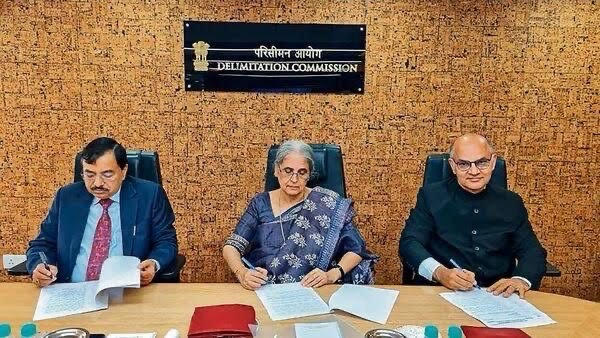
Source : PTI
As India anticipates the 2026 re-apportionment exercise, delimitation emerges as a crucial issue in democratic governance and constitutional law. This paper examines India’s delimitation process, with a primary focus on the judiciary’s longstanding “hands-off” approach and its effectiveness in safeguarding constitutional principles. Central to this analysis is Article 329(a) of the Constitution, a provision that traditionally limits judicial intervention in electoral matters. A transformative 2024 Supreme Court decision in Kishochandra Chhaganlal Rathod v. Union of India has introduced a layer of judicial scrutiny, permitting review in instances of “manifest arbitrariness and irreconcilability to constitutional values”. This paper critically assesses the jurisprudential value of the imminence of elections, reviews landmark precedents, highlights the evolving jurisprudence surrounding ouster clauses, and argues for a nuanced reassessment before exceptions are made. By analysing the Kishorchandra judgement, this paper seeks to contribute to the ongoing discourse on whether delimitation can remain an exclusive policy matter or, if it can be subjected to legal oversight, especially as the 2026 delimitation exercise will test the judiciary’s stance on democratic representation.
I. The Question of Delimitation
Delimitation has emerged as a buzzword in Indian political circles, with States gearing up for the transformative re-apportionment exercise in 2026. Delimitation, the drawing of boundaries, is the sine qua non for elections and is of key importance to the democratic framework of the nation. In countries with first-past-the-post election systems, apportionment is especially critical since the distribution of votes determines the result of elections in any constituency. When the voters supporting any party or candidate even slightly outnumber those of any other competitor, victory is guaranteed. The Constitutional mandate for delimitation of Lok Sabha and State Legislative Assembly seats can be located in Articles 81(2) and 170(2). Article 82 empowers the Parliament to determine the authority and manner in which delimitation is to be undertaken, with the Delimitation Commission Act being enacted in 1952 to constitute an authority for this purpose. Two subsequent delimitation statutes have been enacted in 1962 and 2002, remaining largely similar in content to the 1952 Act.
Part XV of the Constitution, which deals with elections, comprises six provisions, with delimitation featuring under Articles 327 and 329. Article 329 contains two distinct clauses, with clause (a) pertaining to delimitation, and clause (b) pertaining to the elections of candidates. Article 329 in its entirety stipulates an express bar on the jurisdiction of courts with respect to both matters, which are traditionally consistently adhered to by the Constitutional Courts. However, the decision of the Supreme Court in Kishorchandra Chhanganlal Rathod v. Union of India (‘Kishorchandra’) marked a shift in this approach.
This blog shall examine the different facets of this judgement by first outlining how the Supreme Court’s decision remains per curiam despite seeming like a departure from the established law. The next portion assesses the jurisprudential value of the imminence of elections in applying Article 329(a), which serves as a crucial factor to be taken into consideration. The final section analyses the threshold for judicial intervention in delimitation from the lens of manifest arbitrariness and irreconcilability of constitutional values. The authors conclude with an epilogue, wherein they engage with a [1] relevant question in the light of the current political landscape- whether delimitation is a matter of policy or law?
II. Dissecting Kishorchandra
A two-judge bench, comprising Surya Kant and Ujjal Bhuyan JJ., decided Kishorchandra wherein the petitioner had challenged the reservation of the Bardoli Legislative Assembly Constituency for the Scheduled Caste community before the High Court of Gujarat. The High Court had consequently dismissed the petition on the grounds of the bar operating under Article 329(a). Aggrieved, the petitioner moved the Supreme Court, which partially allowed the appeal. It was held that there was nothing precluding the Courts from examining the validity of any law relating to the delimitation of seats in the Lower House or Legislative Assemblies. The Court could grant relief to the petitioner if they are found to be manifestly arbitrary or irreconcilable to Constitutional values.
Kishorchandra is a seminal ruling, marking the Apex Court’s departure from its general principle. While it has examined delimitation matters on merits in the past, it has never expressly carved out an exception to Article 329(a) pertaining to the Lok Sabha and State Legislative Assemblies.
A. Overcoming Article 329(a), Per Curiam
While judicial review is a recognised tenet of the Basic Structure of the Indian Constitution, ouster and finality clauses are instruments to maintain the delicate separation of powers among the various organs of the government. Ouster clauses refer to provisions that prevent judicial oversight of State actions by excluding the jurisdiction of the courts, entailing finality in the decisions of the administrative body. Blanket ouster clauses are often phrased in such a manner that they exclude the jurisdiction of all courts, including the High Courts and Supreme Court.
The Apex Court has softened the strict application of ouster provisions by carving out exceptions that allow Writ Courts to strike down laws, ensuring alignment with Articles 32 and 226. In Kihoto Hollohan v. Zachillhu (‘Kihoto’), the majority decision held that finality and ouster clauses are to be construed strictly, but judicial review cannot be limited in instances where there has been a violation of constitutional mandates, contravention of natural justice, perversity or mala fides. This was reiterated in Raja Ram Pal v. Lok Sabha (‘Raja Ram Pal’) wherein it was held that absolute immunity from judicial review in the context of parliamentary proceedings was untenable. It is evident that ouster clauses do not compel the Supreme Court to abdicate its function as the “final judge of the constitutionality of all acts purported to be done under the authority of the Constitution”.
Article 329 comprises a non-obstante provision, signifying that clauses (a) and (b) shall prevail over other Constitutional provisions. The Supreme Court has routinely adhered to a hands-off approach in this regard. The strongest judicial precedent for Article 329(a) is Meghraj Kothari v. Delimitation Commission, due to its decisive ratio and bench size. In this case, the petitioner challenged the reservation of the Ujjain Parliamentary Constituency for candidates belonging to the Scheduled Castes, and a five-judge bench of the Supreme Court held that the petition was not maintainable. Meghraj entailed a strict application of the ouster clause under Article 329(a) in the light of the facts of the case.
However, the Apex Court has taken a different stance in a line of cases starting from Dravida Munnetra Kazhagam v. State of Tamil Nadu (‘DMK’) and State of Goa v. Fouziya Imtiaz Shaikh (‘Fouziya’). The division bench relied on these decisions with respect to a mirroring provision, Article 243ZG in Part IXA of the Constitution. This provision ousts the jurisdiction of Courts in matters relating to elections to Municipalities. The language of Article 243ZG is identical, mutatis mutandis, to that of Article 329.
DMK was decided by a three-judge bench and the Court held that judicial intervention was permissible in order to facilitate free and fair elections. In Election Commission v, Ashok Kumar, it was held that “anything done towards completing or in furtherance of the election proceedings cannot be described as questioning the election”, with the facts of the case pertaining to Article 329(b). In DMK, the Court extended this principle to delimitation as well, asserting that intervening in the case of any mala fide and arbitrary exercise of power constituted a correction in the election proceedings. Therefore, the decision in DMK was instrumental in shifting the jurisprudence behind a judicial-hands-off approach with reference to election matters.
In Fouziya, a three-judge bench interpreted Article 243ZG in the context of delimitation. On a thorough assessment of the previous judicial precedents relating to this provision, the Court held that the bar under Article 243ZG(a) would not apply to the unique facts of the case. On the more substantive aspects, Fouziya was an extension of the ratio in DMK, and a case for mala fide and arbitrary exercise of power was clearly made out. In these cases, the scope of delimitation-linked ouster clauses was expanded by carving out an exception to the rule, i.e. the mala fide and arbitrary exercise of power.
Kishorchandra refashioned this assessment by asserting that Constitutional Courts could strike down laws relating to delimitation on the grounds of manifest arbitrariness and irreconcilability with constitutional values. Fouziya maintained that the interpretations remained per curiam, and this perspective finds support in Kishorchandra, which held that the limitation on judicial review would apply in most circumstances.
In essence, the rules in the aforementioned cases are to be seen as extensions of the principle laid down in Meghraj, since the Court relied on the jurisprudential rationale behind Article 329(a), which was to prevent the unnecessary vitiation of elections. It is argued that the Constitution Bench in Meghraj did not establish any particular rule concerning the absolute application of Article 329(a), since the imminence of elections played an important role in deciding the case, which shall be analysed further by the authors in the subsequent section. Therefore, Kishorchandra remains per curiam by harmoniously constructing Article 13 and 329(a), and while the realm of review might be limited, it has been carved out nonetheless.
B. Imminence of Elections
The jurisprudential rationale behind Article 329(a) is to preserve the sanctity of elections in a democracy. In Meghraj, the constitutional bench emphasised that treating Delimitation Orders as final is essential to avoid opening a Pandora’s box of endless litigation. Without finality, any voter could potentially halt an election indefinitely by questioning the delimitation of constituencies across various courts. In Fouziya, the Apex Court upheld a similar principle, underscoring that once elections are notified, judicial intervention must cease until results are declared. This hands-off approach mandates that the election process, once initiated, remains uninterrupted.
While the concern that litigation may impede the electoral process is indeed legitimate, it should not overshadow the paramount constitutional values and fundamental rights of citizens. Recognising this proposition of law, the United Kingdom allows for judicial intervention in the delimitation process if the institutions involved exercise arbitrary power and thus violate these rights. An example of such displays of arbitrary power is gerrymandering of electoral districts.
In the United States, where gerrymandering has deeply influenced political history, the Supreme Court ruled in 1993 that electoral districts with boundaries seemingly based solely on race may be challenged under the Equal Protection Clause. Following suit, the Indian Supreme Court has also recognised gerrymandering as a threat to the delimitation process in the case of State of Madhya Pradesh & Ors, v. Devilal. The Court addressed the concern of gerrymandering, stating that if proven, the order would be deemed invalid. In such a scenario, while delimitation may ensure adequate representation for some communities, there is a significant risk that it may result in the disenfranchisement or exclusion of others for partisan reasons.
Although elections traditionally fall within legislative and executive prerogatives, the judiciary reserves the power to intervene when delimitation actions are arbitrary or motivated by mala fides. In doing so, the courts recognise a carefully crafted exception to Article 329(a), affirming that electoral boundaries must serve public interest and uphold fundamental rights. The Kishorchandra decision solidifies this exception.
C. Understanding Manifest Arbitrariness and Irreconcilability to Constitutional Values
The doctrine of manifest arbitrariness was first articulated by the Supreme Court in Shayara Bano v. Union of India(‘Shayara Bano’), and this principle has been firmly entrenched in Indian jurisprudence. Shayara Bano in its explanation of the doctrine of arbitrariness builds upon the principles laid down in Indian Express Newspaper (Bombay) (P) Ltd. v. Union of Indiafor subordinate legislationand extends them to plenary legislation. While the Supreme Court in Kishorchandra did not deem the delimitation exercise undertaken in Gujarat to be invalid, it carves out a clear exception in this regard.
Delimitation Orders, remain a form of subordinate legislation, which may be challenged on the grounds of exceeding the authority granted by the parent act, contravening constitutional provisions, and if the parent act itself is ultra vires the Constitution. Based on the facts and circumstances of a case, subordinate legislation may be invalidated as arbitrary or contrary to the statute if it disregards crucial facts that the statute or the Constitution explicitly or implicitly requires it to consider. The Kishorchandra verdict has, therefore, expanded the scope for judicial review of Delimitation Orders, previously regarded as beyond the judiciary’s purview.
III. Epilogue and Way Forward
The question of whether delimitation falls strictly within the domain of policy or is subject to judicial oversight as a matter of law lies at the heart of constitutional interpretation and democratic governance. Delimitation, is essential in a democracy, where it supports the ideal of political equality by aiming to create constituencies of roughly equal population size, ensuring that each vote carries similar weight.
However, this principle is not always straightforward in practice. The concept of ‘one man, one vote, one value’ is in its nature considerably tolerant of imbalances and departures from a very strict application and enforcement. Even with equal vote weighting, minority participation can be compromised if minority votes are qualitatively diluted. The constitutional principle of proportionate representation serves as a broad guideline incorporating variations in political development across regions. Consequently, delimitation has become an arena for policy choices that weigh the need for equitable representation against the pragmatic considerations of governance and national cohesion.
The policy-driven nature of delimitation is evident deferring population-based seat allocation, as seen in the 42nd and 84th amendments, which froze seat distribution based on the 1971 census until 2026 to encourage population control. While constitutional philosophy champions equal representation, practical politics balances stability with equity. However, disparities in population control between the southern and north-eastern states versus larger northern and western states, undermine rationale of the 1971 freeze, threatening the political significance of states that managed population growth effectively.
As established in preceding sections, the Indian Constitution enshrines the “separation of powers,” assigning policy formulation and execution to the executive while limiting judicial intervention. However, in DDA v. Joint Action Committee, Allottee of SFS Flats, the Apex Court held that while the judiciary should avoid micro-managing policy, a complete hands-off approach is unwarranted. Judicial review is permissible if policies are unconstitutional, exceed statutory limits, or contradict broader frameworks, ensuring constitutional accountability without encroaching on executive functions. The Kishorchandra decision aligns with the evolving judicial stance on delimitation, reaffirming that while primarily a policy-driven process, it is not entirely immune from judicial scrutiny. The Court’s recognition that delimitation orders may be reviewed when they conflict with constitutional provisions or exhibit manifest arbitrariness introduce a crucial safeguard against executive overreach. This shift aligns with broader constitutional principles, balancing the separation of powers with the judiciary’s role in upholding fundamental rights and democratic integrity. The upcoming 2026 Delimitation exercise will mark the first application of these evolving judicial standards, setting the stage for potential repercussions as these intersecting legal and policy frameworks are tested in practice.
*Arohi Malpani and Simone Vaidya are 2nd year students at MNLU Mumbai.
 Law School Policy Review